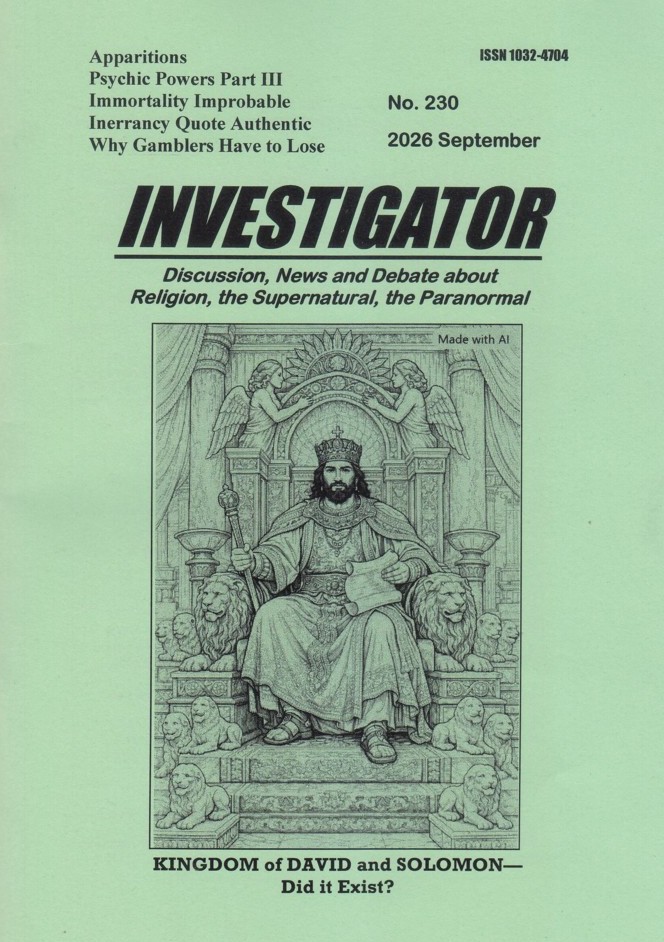
Image produced by Copilot
https://.microsoft.copilot.com (2026)
THE DAVID-SOLOMON KINGDOM:
EVIDENCE INCREASING
Anonymous
(Investigator 230, 2026 September)
EVIDENCE INCREASING
Anonymous
(Investigator 230, 2026 September)
INTRODUCTION
The existence
of Israel and Judah as a "United Monarchy" by 1000 BCE, ruled by David
and Solomon, is taught in the Bible but denied by many critics. Then an
inscription on pottery discovered in 2008 provided new evidence.
Recently I wondered how the debate is progressing and asked Copilot: "Is there further information about the pottery shard found in 2008 at Khirbet Qeiyafa, dated 10th century BC, translated by Gershon Galil?"
Recently I wondered how the debate is progressing and asked Copilot: "Is there further information about the pottery shard found in 2008 at Khirbet Qeiyafa, dated 10th century BC, translated by Gershon Galil?"
Khirbet Qeiyafa is a 6-acre site
30km SW of Jerusalem. Before reading Copilot's analysis note that some
archaeologists identify Khirbet Qeiyafa with biblical Shaarayim.
(Joshua 15:36; 1 Samuel 17:32; 1 Chronicles 4:31) In Investigator
#50 my provisional count found 897 geographical locations named in the
Old Testament with 311 confirmed and 228 tentatively identified. I
included Shaarayim with the 228 tentatively confirmed, but its
identification is now more definite:
Khirbet Qeiyafa
(Elah Fortress), recently proposed as the biblical Sha'arayim, is an
archaeological site overlooking the Elah Valley where, according to the
Biblical account, David fought Goliath. It was a key location in the
kingdom of Judah along the main road from Philistia and the Coastal
Plain to the eastern Hill Country...
The site is dated by pottery styles and by burned olive pits tested for carbon-14 at Oxford University and found to date from between 1050 and 970 B.C.
The initial excavation by Saar Ganor and Yosef Garfinklel was August 12 to 26, 2007 on behalf of the Hebrew University of Jerusalem, Institute of Archaeology. In 2008 they identified the site with biblical Sha'arayim. (Wikipedia)
The site is dated by pottery styles and by burned olive pits tested for carbon-14 at Oxford University and found to date from between 1050 and 970 B.C.
The initial excavation by Saar Ganor and Yosef Garfinklel was August 12 to 26, 2007 on behalf of the Hebrew University of Jerusalem, Institute of Archaeology. In 2008 they identified the site with biblical Sha'arayim. (Wikipedia)
COPILOT'S ANALYSIS
The Khirbet Qeiyafa ostracon remains one of the earliest long alphabetic inscriptions from Iron Age Judah (late 11th–early 10th century BCE).
Yes — there is
further information, but the key point is this: no new
major decipherment or scholarly consensus has emerged beyond what the
debates already established between 2009–2012. What we have today is a
clearer picture of how scholars view Gershon Galil’s translation and
how it fits into the broader epigraphic and archaeological context.
Gershon Galil’s
2009–2010 translation — a social justice oriented Hebrew text —
is still one proposed reading, but it is not accepted as consensus.
Most scholars consider the text too fragmentary for a definitive
translation, though they agree it is extremely important evidence for
early literacy in Judah.
The Ostracon is a 15 × 16.5 cm ink inscription on a pottery sherd:
•
Found in 2008 at Khirbet Qeiyafa (Elah Valley), in a secure destruction
layer.
• Dated by C 14 of olive pits and pottery typology to late 11th / early 10th century BCE.
• Written in early alphabetic / Proto Canaanite / early Hebrew script.
• The longest inscription of its type from this period.
• Dated by C 14 of olive pits and pottery typology to late 11th / early 10th century BCE.
• Written in early alphabetic / Proto Canaanite / early Hebrew script.
• The longest inscription of its type from this period.
Galil Proposed (2009–2010) that:
•
The language is Hebrew.
• The text contains ethical/legal exhortations similar to biblical themes (care for widow,
orphan, stranger, poor).
• Several words are “exclusively biblical.”
• The inscription reflects a social-justice ideology akin to Deuteronomy or Isaiah.
• The text contains ethical/legal exhortations similar to biblical themes (care for widow,
orphan, stranger, poor).
• Several words are “exclusively biblical.”
• The inscription reflects a social-justice ideology akin to Deuteronomy or Isaiah.
His translation (representative excerpt):
•
"Judge the slave and the widow… plead for the infant… rehabilitate the
poor at the hands
of the king… protect the poor and the slave…"
of the king… protect the poor and the slave…"
This reading became widely publicized through a University of Haifa press release.
Scholarly Response
1. The text is
too fragmentary for a secure translation. Leading epigraphers such as
Christopher Rollston and Émile Puech argue that:
•
Many letters are uncertain or missing.
• Galil’s reading fills gaps beyond what the visible strokes justify.
• A continuous, confident translation is not possible.
• Galil’s reading fills gaps beyond what the visible strokes justify.
• A continuous, confident translation is not possible.
2. The language may be Hebrew — but this is not certain.
•
Some scholars (e.g., Garfinkel) accept it as early Hebrew.
• Others say it could be Canaanite, Phoenician, or a transitional dialect.
• The script is early enough that linguistic boundaries are blurred.
• Others say it could be Canaanite, Phoenician, or a transitional dialect.
• The script is early enough that linguistic boundaries are blurred.
3. The genre is likely administrative or legal. Even critics of Galil agree the text probably concerns:
•
legal matters
• social obligations
• administrative instructions
• social obligations
• administrative instructions
4. The inscription does demonstrate early literacy in Judah. This is the strongest consensus point:
•
It shows someone at a frontier fortress around 1000 BCE could write
extended prose.
• This challenges minimalist claims that Judah lacked scribal culture in David’s era.
• This challenges minimalist claims that Judah lacked scribal culture in David’s era.
Additional Insights
Direction of writing:
•
The inscription is written left to
right, unusual for later Hebrew.
• This suggests an early stage of alphabetic writing.
• This suggests an early stage of alphabetic writing.
Content themes
(inferred, not universally accepted). Some reconstructions, including
Galil’s and others, emphasize:
•
care for widows, orphans, strangers
• legal responsibility
• royal intervention for justice
• legal responsibility
• royal intervention for justice
These themes overlap with biblical ethics, but the connection is interpretive, not proven.
Archaeological Context
•
Khirbet Qeiyafa was a fortified
Judahite city with two gates (possibly biblical
Sha‘arayim).
• The ostracon was found in a casemate wall room, suggesting an administrative function.
Sha‘arayim).
• The ostracon was found in a casemate wall room, suggesting an administrative function.
What has developed since 2010 is:
•
Clearer scholarly caution about overconfident readings.
• Stronger archaeological consensus about early Judahite literacy.
• Multiple alternative epigraphic analyses, none of which provide a full translation.
• No new inscriptional data — the ostracon is too damaged for further decipherment.
• Stronger archaeological consensus about early Judahite literacy.
• Multiple alternative epigraphic analyses, none of which provide a full translation.
• No new inscriptional data — the ostracon is too damaged for further decipherment.
In short:
Galil’s translation remains one influential proposal, but not the accepted reading.
The ostracon’s significance lies more in its existence than in any single translation.
What this implies for the United Monarchy
Short answer:
The Khirbet
Qeiyafa ostracon strongly supports the existence of a literate,
organized Judahite polity in the early 10th century BCE, which in turn
strengthens the historical plausibility of a United Monarchy under
David and Solomon. It does not prove the biblical narrative, but it
undermines the minimalist claim that Judah at this time was a tiny,
illiterate chiefdom incapable of state formation.
Core Historical Implication
The ostracon demonstrates that around 1000 BCE, Judah possessed:
•
Fortified urban centers (Khirbet Qeiyafa itself)
• Administrative infrastructure (casemate-wall rooms, storage facilities)
• Scribal activity and extended alphabetic writing
• A legal/administrative culture (even if the exact text is disputed)
• Administrative infrastructure (casemate-wall rooms, storage facilities)
• Scribal activity and extended alphabetic writing
• A legal/administrative culture (even if the exact text is disputed)
These are the
hallmarks of an emerging state,
not a tribal village society. This directly challenges the minimalist
position that the United Monarchy was a later literary invention.
1. State Formation: What Qeiyafa Shows About Judah
Archaeology at Qeiyafa reveals:
•
A planned, fortified city with casemate walls and two gates — unique in
the region.
• Occupation for 20–40 years, precisely in the early 10th century BCE.
• No pig bones, matching Judahite dietary patterns and contrasting with Philistine sites.
• A strategic position controlling the Elah Valley frontier.
• Occupation for 20–40 years, precisely in the early 10th century BCE.
• No pig bones, matching Judahite dietary patterns and contrasting with Philistine sites.
• A strategic position controlling the Elah Valley frontier.
These features indicate:
•
Central planning
• Resource mobilization
• Military strategy
• Administrative oversight
• Resource mobilization
• Military strategy
• Administrative oversight
All of which imply a central authority — consistent with an early Judahite kingdom.
2. Literacy and Bureaucracy: Why the Ostracon Matters
The ostracon is:
•
One of the earliest long alphabetic inscriptions in the region
• Written in proto-Canaanite / early Hebrew script
• Evidence that scribes were active in a frontier fortress
• Written in proto-Canaanite / early Hebrew script
• Evidence that scribes were active in a frontier fortress
This matters because:
•
A functioning state requires record keeping, legal communication, and
trained scribes.
• Minimalist scholars long argued that Judah lacked literacy until the 8th–7th centuries BCE.
• Qeiyafa pushes literacy two centuries earlier.
• Minimalist scholars long argued that Judah lacked literacy until the 8th–7th centuries BCE.
• Qeiyafa pushes literacy two centuries earlier.
Thus, the
ostracon supports the idea that David's
Judah had the administrative capacity to produce written
traditions, maintain garrisons, and govern territory.
3. The Content Debate: Why It Still Helps the United Monarchy Case
Even though scholars disagree on the exact translation, they agree on the genre:
•
Legal
• Administrative
• Possibly ethical or
• judicial
• Administrative
• Possibly ethical or
• judicial
All interpretations point to organized governance, not tribal subsistence life.
Puech’s reading
— linking the text to the formation of the Kingdom of Israel and
possibly even Saul’s coronation — is not consensus, but it shows how
the inscription fits comfortably within a context of early monarchy.
4. Implications for the United Monarchy Debate
A. Strengthens the maximalist/traditional view. The evidence supports:
•
A centralized Judahite authority around 1000 BCE
• Urban planning and fortification projects
• Literacy and administrative culture
• A border defense system consistent with a kingdom under David
• Urban planning and fortification projects
• Literacy and administrative culture
• A border defense system consistent with a kingdom under David
This makes the biblical description of a developing monarchy historically plausible.
B. Weakens the minimalist view
Minimalists argued:
•
Judah was too small and poor to build fortified cities
• Literacy was absent
• No evidence of statehood before the 8th century
• Literacy was absent
• No evidence of statehood before the 8th century
Qeiyafa contradicts all three claims.
C. Does not prove the biblical narrative. The ostracon does not:
•
Mention David
• Mention Jerusalem
• Confirm the extent of the kingdom
• Mention Jerusalem
• Confirm the extent of the kingdom
But it shows that the kind of society described in Samuel–Kings could have existed.
5. Synthesis: What Historians Now Generally Accept Based on the inscription and the site:
1. Judah was
already forming a state by ca. 1000 BCE.
2. Literacy existed earlier than previously thought.
3. Fortified cities were being built under centralized authority.
4. The United Monarchy is historically plausible, though not proven.
2. Literacy existed earlier than previously thought.
3. Fortified cities were being built under centralized authority.
4. The United Monarchy is historically plausible, though not proven.
This shifts the debate from "Did the United Monarchy exist?" to "How large and complex was it?"
REFERENCES:
https://.microsoft.copilot.com (2026)
Khirbet Qeiyafa Ostracon
Investigator #50
Names In The Old Testament: Skeptics Challenged!
Wikipedia:
https://en.wikipedia.org/wiki/Khirbet_Qeiyafa
https://en.wikipedia.org/wiki/Khirbet_Qeiyafa_ostracon