Six artices appear below:
1 Reason and Religion
2 Reason and Religion in #221 Needs More Reason
2 Reason and Religion in #221 Needs More Reason
3 Reply to Anonymous On Reason and Religion
4 "Reason and and Religion" Again Needs More Reason
5 Reason & Religion - A Final Reply
6 Straugen's "Reason and Religion" (#225) Loses More Reason
4 "Reason and and Religion" Again Needs More Reason
5 Reason & Religion - A Final Reply
Reason and Religion
(Investigator 221, 2025 March)
(Investigator 221, 2025 March)
Kirk Straughen
The primary
axiom of this essay is that no genuine merit can be intrinsic to
unfounded beliefs, and that it is better to embrace truth rather than
falsehood. Therefore, if aspects of religion are unlikely to be true,
then these elements cannot be essential for the perpetuation of what is
good in human nature and society.
Many people are reluctant to question their religious beliefs, perhaps because they are afraid of what they may find. Knowledge, however, is never born of fear. Fear can only stifle us; fear can only hinder our efforts to comprehend the human condition and our place in the cosmos. The fearless pursuit of the truth is the only way forward, and it is only through this understanding that true wisdom and progress for humanity can be assured.
Unfortunately, there is often a conflict between religion and reason as exemplified by science. This is partly due to the antiquity of theology: religious beliefs have been with us for so long that they have become ingrained in the human psyche. The sanctity of age makes us forget that many of the supernatural beliefs we take for granted were formulated in the childhood of civilisation, roughly some six thousand years ago. Needless to say, our knowledge has increased considerably since those ancient times.
Many people are reluctant to question their religious beliefs, perhaps because they are afraid of what they may find. Knowledge, however, is never born of fear. Fear can only stifle us; fear can only hinder our efforts to comprehend the human condition and our place in the cosmos. The fearless pursuit of the truth is the only way forward, and it is only through this understanding that true wisdom and progress for humanity can be assured.
Unfortunately, there is often a conflict between religion and reason as exemplified by science. This is partly due to the antiquity of theology: religious beliefs have been with us for so long that they have become ingrained in the human psyche. The sanctity of age makes us forget that many of the supernatural beliefs we take for granted were formulated in the childhood of civilisation, roughly some six thousand years ago. Needless to say, our knowledge has increased considerably since those ancient times.
There can be little doubt that religion has caused and is still causing
a great deal of harm throughout the world, especially when it adopts an
intransigent stance as the below reaction to the Covid Pandemic
illustrates.
According to
The New York Times, millions of White evangelical adults in the United
States don't intend to be vaccinated against COVID-19. This poses many
challenges to battling the virus, including the prevention of herd
immunity. According to religious studies scholars from the College of
Liberal Arts, this group's justification for not getting vaccinated
lies in both their religious and political beliefs…
"There's several different religious beliefs and doctrines associated with evangelicals, especially the belief in inerrancy of scripture, which is the belief that the Bible is the literal word of God," Campbell explained [religious studies professor Heidi Campbell]. "There's also a general kind of theological belief in the sovereignty of God, that He is the one who knows best. So if you get sick, it's because you don't have faith in God and that you're not living a holy life, so God isn't able to protect you."
"There's several different religious beliefs and doctrines associated with evangelicals, especially the belief in inerrancy of scripture, which is the belief that the Bible is the literal word of God," Campbell explained [religious studies professor Heidi Campbell]. "There's also a general kind of theological belief in the sovereignty of God, that He is the one who knows best. So if you get sick, it's because you don't have faith in God and that you're not living a holy life, so God isn't able to protect you."
In addition to
spreading anti-vaccine ideology in America, this belief in the supreme
authority of God has also affected vaccine efforts abroad. For example,
a hospital in Uganda recently received 5,000 doses of a vaccine, but
was only able to administer about 400 doses because of vaccine
hesitancy among a heavily evangelical population.
"According to
evangelical groups in other parts of the world, taking the vaccine is
like saying 'I don't have faith and I'm not holy,' and it's challenging
their faith in that way," Campbell said. And that's one reason why the
vaccine debate is not about personal health, but about freedom, since
it questions their religious identity and their right to practise it in
a certain way." (1)
Faith is ineffective when it comes to protecting people from disease.
This can be seen by the fact that many evangelical churches in Latin
America were hit hard by COVID-19 due to flouting health guidelines
designed to prevent the spread of the virus. Indeed, some church
leaders even claimed that the virus kills those of little faith. (2)
Much of the
harm that the various creeds have wrought is not so much the result of
the creation of negative impulses by theology, but the sanctioning of
such urges and erroneous beliefs by conferring on them an allegedly
divine approval, thereby justifying what under any other circumstances
would be seen by normal people as wanton cruelty and ignorance of the
basest kind. For example:
"Slaves, obey
your earthly masters with respect and fear, and with sincerity of
heart, just as you would obey Christ." Ephesians 6:5.
Slave owners
and pro-slavery pastors used the above passage to justify the African
slave trade up until the 19th century. Titus 2:9 was similarly popular,
proclaiming, "Teach slaves to be subject to their masters in
everything, to try to please them, not to talk back to them."
Jefferson Davis, president of the Confederate States during the American Civil War, said that slavery "was established by decree of Almighty God . . . it is sanctioned in the Bible, in both Testaments, from Genesis to Revelation."
Jefferson Davis, president of the Confederate States during the American Civil War, said that slavery "was established by decree of Almighty God . . . it is sanctioned in the Bible, in both Testaments, from Genesis to Revelation."
The Bible was
used to justify not just slavery in general but the inferiority of
"dark-skinned peoples" in particular. Many theologians interpreted the
cursed Canaanites from Abrahamic mythology as having dark skin. Their
progenitor is Ham, the son of Noah, and people misread the Hebrew word
for Ham to mean "black" or "dark." This particular Bible passage has
been used throughout history to justify the oppression of whomever it
was convenient to oppress.
Even today, the
story of Ham is still quoted by those who believe in racial
segregation. The pastor of Appleby Baptist Church in Nacogdoches, Texas
wrote on his website in 2013 that "the proof of the presence of God
among the Israelites was the absence of the black skinned folk of
Canaan." He said that God is a separator rather than a mixer, and
interracial marriages are the work of the devil.(3)
So, is dark skin a sign of inferiority, and are interracial marriages the work of the devil? Here is what modern science has to tell us about alleged racial inferiority and racial purity.
So, is dark skin a sign of inferiority, and are interracial marriages the work of the devil? Here is what modern science has to tell us about alleged racial inferiority and racial purity.
The primary
pigment in human skin is melanin. It's used to protect us from the sun.
It absorbs the sun's ultraviolet rays before they can destroy folate,
one of the body's key vitamins. Many genes are involved in the
biochemical pathways that result in melanin production. Natural
variation within these genes is the root cause of the spectrum of skin
tones that humans have.
So, the biggest genetic difference within the human race is between white people and black people, right? Wrong.
So, the biggest genetic difference within the human race is between white people and black people, right? Wrong.
Firstly, all humans share almost all the same DNA - a fact that betrays all of our recent origins from Africa.
Secondly, there is more genetic diversity on the continent of Africa than in the rest of the world put together.
Two people from
different tribes in Southern Africa will be more genetically different
from each other than a Sri Lankan, a Māori and a Russian. We might
categorise people as white, black or brown, but these visual variations
don't accurately reflect the genetic differences — or rather
similarities — between us…
We think of certain areas, lands or peoples as being isolated — either physically or culturally — and these boundaries as being insurmountable. But this is neither what history, nor genetics, tell us. In fact, no nation is static.
We think of certain areas, lands or peoples as being isolated — either physically or culturally — and these boundaries as being insurmountable. But this is neither what history, nor genetics, tell us. In fact, no nation is static.
"People have moved around the world throughout history, and had sex whenever and wherever they could," says Dr Rutherford.
Sometimes these are big moves in short times. More often, people are largely static over a few generations — and that can feel like a geographical and cultural anchor.
"Nevertheless, every Nazi has Jewish ancestors,"
says Dr Rutherford, "Every white supremacist has Middle Eastern
ancestors. Every racist has African, Indian, East Asian ancestors, as
well as everyone else."
"Racial purity is pure fantasy. For humans, there are no pure bloods. Only mongrels enriched by the blood of multitudes," he says. (4)
"Racial purity is pure fantasy. For humans, there are no pure bloods. Only mongrels enriched by the blood of multitudes," he says. (4)
Scientific
research has revealed that the genetic differences between groups are
negligible. Regardless of race, we are all more alike than different.
In fact any two unrelated human beings on the planet are 99.9% identical in their DNA sequence. Only 0.1% varies, and here's the most important takeaway message from all this. It also happens to be the most replicated finding in the scientific literature on human variation.
Of this 0.1% that varies, (95.7% to be exact) is found between individuals within the same race. Despite what our eyes perceive, there is more genetic diversity within a race than between races. (5)
It should be clear that vaccines are more effective than prayer, and that racism is refuted by science. But it is insufficient merely to expose the flaws of faulty beliefs. In addition, one must offer a more satisfactory world view that will benefit humanity, and in my opinion, this view is the philosophy of rationalism and science.
The basic premise of rationalism is that our minds can comprehend the true nature of the universe without recourse to supernatural revelation. This philosophy forms the core of the methodology of science, where theories about the world are based on observation and experiment, encompass all previously verified facts relating to the phenomena under investigation, and can be used to make testable predictions that are then examined by independent researchers to confirm their veracity.
In fact any two unrelated human beings on the planet are 99.9% identical in their DNA sequence. Only 0.1% varies, and here's the most important takeaway message from all this. It also happens to be the most replicated finding in the scientific literature on human variation.
Of this 0.1% that varies, (95.7% to be exact) is found between individuals within the same race. Despite what our eyes perceive, there is more genetic diversity within a race than between races. (5)
It should be clear that vaccines are more effective than prayer, and that racism is refuted by science. But it is insufficient merely to expose the flaws of faulty beliefs. In addition, one must offer a more satisfactory world view that will benefit humanity, and in my opinion, this view is the philosophy of rationalism and science.
The basic premise of rationalism is that our minds can comprehend the true nature of the universe without recourse to supernatural revelation. This philosophy forms the core of the methodology of science, where theories about the world are based on observation and experiment, encompass all previously verified facts relating to the phenomena under investigation, and can be used to make testable predictions that are then examined by independent researchers to confirm their veracity.
It is important
to remember that scientific theories are not statements of absolute
truth about the nature of the universe because new evidence may require
their modification. This fact is not a weakness. On the contrary, it is
a strength, for it enables science to change in the face of new
findings, and thereby arrive at a more accurate understanding of the
Cosmos. However, because we are not omniscient beings, the goal of
ultimate truth shall be forever beyond our grasp.
As can be seen,
there is a profound difference between the rules of enquiry that govern
science and the assumptions of religion. Religion is largely dogmatism
based on faith rather than sound evidence; whereas in science
scepticism is considered an invaluable aid in the quest for truth. All
claims must be supported by sound evidence in order to be accepted.
Moreover, unhindered investigation and independent examination is
encouraged because only this can expose falsehood. Indeed, any belief
system that does not incorporate self-correcting mechanisms is unlikely
to advance human understanding, and runs the risk of being trapped in
an intellectual dead-end.
References
1. Why Evangelicals are Encouraging the Anti-Vaccination Movement
https://liberalarts.tamu.edu/blog/2021/05/04/why-evangelicals-are-encouraging-the-anti-
vaccination-movement/
2. Evangelical Churches Hit Hard by Coronavirus in Latin America as Many Flout Guidelines.
https://www.nbcnews.com/news/latino/evangelical-churches-hit-hard-coronavirus-latin-
america-many-flout-guidelines-n1238431
3. 10 Religious Verses Used To Justify Terrible Atrocities
https://listverse.com/2014/03/20/10-religious-verses-used-to-justify-terrible-atrocities/
4. How to argue with a racist: Five myths debunked
https://www.bbc.com/news/science-environment-51914782
5. Are You There, Race? It's Me, DNA
https://www.mcgill.ca/oss/article/health-general-science/are-you-there-race-its-me-dna
Tennessee Pastor Rails Against Interracial Marriage
https://www.splcenter.org/hatewatch/2014/02/19/tennessee-pastor-rails-against-interracial-
marriage
"REASON AND RELIGION" in #221 NEEDS MORE REASON
Anonymous
(Investigator 222, 2025 May)
Anonymous
(Investigator 222, 2025 May)
Unfounded and misleading criticisms of the Bible lack merit. They hinder the wisdom and progress civilized society will need for its survival. It is better therefore to embrace truth.
Mr Straughen's error in Investigator #221 is that although he discussed religions "throughout the world" he cherry picked foolish ones to represent the lot. It is like judging science by focusing on the few academics who claim Earth is 6000 years old or falsify experimental results, and ignoring all scientists who make useful new discoveries. Seeking out the bad apples and ignoring the good is the same error racists make to support racism.
VACCINATIONS
Straughen
refers to religious people who oppose vaccinations but he forgot that
many non-religious people do too. Today's opposition to vaccinations
was boosted by rogue academics who claimed vaccinations are a
conspiracy between health agencies and vaccine manufacturers. These
academics are the main authority for fringe Christians and others who
reject vaccinations, not the Bible. Middap (2025) writes: "The
elevation of vaccine sceptic Robert F. Kennedy Jr to US health
secretary ... has emboldened hardcore anti-vaccination groups..." Are
these "hardcore groups" all church members?
That vaccines
are safe is seen from the numbers. President Joe Biden, after taking
office during the Covid epidemic, sought to make the US the world's
"vaccine arsenal". 130 million doses were soon distributed from the US
to 90 countries and a further 500 million doses purchased specifically
for Africa. If we consider all illnesses the vaccinations worldwide
every year number many billions.
Another "fearless pursuit of the truth" is the Christian origin of modern vaccinations.
In "The Origins
of Medical Science" (#212) I quoted Jesus that his followers would do
"greater works" than he did. Edward Jenner (1749-1823), "a Christian
who treasured the Bible", investigated smallpox, one of the greatest
killers of humans. Jenner demonstrated the efficacy of vaccination
against smallpox and popularized it. Napoleon had his troops
vaccinated, Spain sent a three-year expedition to its colonies to
vaccinate people, and nation after nation adopted vaccination.
Jenner's work
was the foundation for subsequent discoveries in immunology. He has
been called "the man who saved a billion lives". Vaccination eradicated
smallpox worldwide in the 1970s. In Investigator #212 I gave many
further examples to show that modern medical science was largely
founded by Christians.
SLAVERY
Straughen
claims that slavery in the USA's southern states was "wanton cruelty
and ignorance of the basest kind" and was supported by the Bible.
We discussed all that in Investigator 76-84. But, as Kevin Rogers noted, Straughen waits for the dust to settle and then repeats his errors. So let me summarize what I showed previously.
We discussed all that in Investigator 76-84. But, as Kevin Rogers noted, Straughen waits for the dust to settle and then repeats his errors. So let me summarize what I showed previously.
Old Testament
slavery in Israel was limited by the Law of Moses to six years with a
further amnesty every 50th calendar year. Slavery was intended to pay
off debts and the slaves treated the same as hired laborers. A slave
escaping from harsh treatment could not be returned to his master. Old
Testament slavery was so beneficial that some Israelite slaves wanted
to remain slaves permanently and Moses' Law included a provision to do
this.
Slavery was not
based on "race" or skin color. Skin color was so irrelevant the Bible
ignores it except for the "black" girl in the Song of Solomon (1:5-6)
who may have meant her sun-tan, and Jeremiah asking "can the Ethiopian
change his skin?" (13:23)
In editions #76 to #84 I distinguished slavery from benign slavery.
The King James
Bible implies this difference by translating the Hebrew word as
"servant". Where something is very different to something else, such as
the difference between Old Testament servitude and American or Islamic
slavery, it assists clear thinking to have different words. Imagine the
confusion if we didn't have words for sugar, flour, salt, cocaine and
sodium cyanide and called it all "white substance"!
This is the
confusion that Straughen, as well as Bible translations that translate
the Hebrew word as "slave", bring to the discussion. Most people have
seen movies about American slavery, or heard about Islamic slavery, and
assume all slavery is like in the movies and get indignant against the
Bible.
Old Testament servitude, however, was nearer to modern contract work
which Google Search defines: "Contract laborer is any non-employee
hired for a specific project and/or a limited predetermined time period
to be performed for a specific price."
If Straughen
owed a neighbor money but makes a contract to
pay off the debt by living on the neighbor's property and working
for him for a set time period — that's similar to Old Testament servitude. It's nothing evil
— debts ought to be repaid. All of Australia's laws would still protect
Mr Straughen just as Moses' law, including the Ten Commandments,
protected people, whether free or servants, in Israel.
Straughen, back
in 2001, argued "slavery with a less brutal face is still slavery, and
therefore just as wrong..." However, anything can be done badly and
dangerously or with precautions and safely. People occasionally die on
work-sites or at work. Therefore laws are enacted to make work-sites
safer. We don't argue "work or a worksite with a less brutal face is
still work and just as wrong."
Old Testament
servitude differed to the cruelty other nations practiced. It was
ethics 3500 years ahead of the times and demonstrated the truth of:
"And what great nation is there, that has statutes and ordinances so
righteous as all this law which I set before you this day?"
(Deuteronomy 4:8)
In New
Testament times Christians encountered Roman slavery and the Scriptures
instructed "obey your earthly masters...as you would obey Christ"
(Ephesians 6:6) and "whole heartedly" (Colossians 3:22). Better advice
could not be given because runaway slaves who were caught were
executed, often in horrid ways. However, slaves who gave outstanding
service could earn their freedom, and Rome had many freed slaves.
The New Testament taught "become free if possible". (I Corinthians
7:21) The doctrine that all humans belong to God firstly by creation,
and secondly because Christ's death "ransomed" or purchased them,
opposed slavery by implication.
Straughen
quotes President Jefferson Davis that Almighty God established slavery.
Slavery in the Confederate States was the source of white peoples'
wealth and comfortable lives. Due to this "conflict of interest" their
pro-slavery comments were no more objective or impartial than Adolf
Hitler's views about Russians. Adherence to the Bible could have cured
Confederate hypocrisy and prevented the Civil War which killed 600,000
people:
"But those who
want to be rich fall into temptation and are trapped by many senseless
and harmful desires that plunge people into ruin and destruction. For
the love of money is the root of all sorts of evil, and in their
eagerness some have wandered away from the faith..." (I Timothy
6:9-10)
America had
hundreds of abolitionist groups, many of them Christian, who published
pamphlets (and some books) showing that Southern slavery was
anti-Christian.
One
abolitionist was Susan B. Anthony (1820-1906) a Quaker, Unitarian and
later partly agnostic. She collected anti-slavery petitions as a
teenager and became pivotal in abolitionism and the women's rights
movement. In 1863 Anthony with associate Elizabeth Stanton (1815-1902)
campaigned for an amendment to the Constitution to abolish slavery.
They collected 400,000 signatures which helped in the passage of the
Thirteenth Amendment which ended slavery in the U.S. A postage
stamp with Anthony's image was issued in 1936.
In Roman times
Christians purchased, when possible, the freedom of Christian
slaves. Today "slave redemption" still occurs but the bad guys now are
not the Romans but Islam in Africa and the Caste system in India.
Focus
magazine (September 2001) reported that Baroness Caroline Cox for
Christian Solidarity Worldwide paid $US24,000 to free 353 slaves,
mainly women and children, in Sudan. Slavery in Sudan had been
eliminated by the British but returned in 1989 when the National
Islamic Front took power and mobilized Islamic tribesmen to kidnap
Christians for slavery and forced conversion as part of Jihad and the
Islamizing of Southern Sudan. Slaves are also exported to Libya, Chad,
Mauritania and Persian Gulf lands. Eads (1996) wrote: "Captives are
treated brutally. They are branded, beaten and sexually abused. Slaves
who try to escape are beaten, mutilated or murdered."
Bita (2002)
reported: "The International Labor Organisation estimates that 8.4
million children work as slave labourers, prostitutes or soldiers
worldwide. Of these 1.2 million children are kidnapped, sold or
smuggled each year." The Global Slavery Index estimated 35.8 million
slaves worldwide in 2015, about 40% of them due to India's caste
system. This exceeds all the slaves taken from Africa to the Americas
during 300 years!
Britain did more than any other country to fight slavery. (Metaxas
2008) A bill for slavery's abolition was passed in Britain in
1807. Britain and the US signed a treaty in 1808 banning the
slave trade. Spain signed in 1817. Famous British Christian
abolitionists included:
• William Wilberforce 1759-1833
• Charles Spurgeon 1834-1892
• John Wesley 1703-1791
• John Newton 1725-1807
• Charles Spurgeon 1834-1892
• John Wesley 1703-1791
• John Newton 1725-1807
Newton worked in the slave trade; became himself a slave in Sierra
Leone; and afterwards a Christian cleric and prominent
abolitionist.
ANOTHER SLAVERY
There is
another slavery that the Bible speaks of from which Jesus came to
rescue the world — enslavement to all sorts of evil behavior: "Everyone
who commits sin is a slave to sin." (John 8:34; Romans 6:17-18)
Straughen shows himself a slave to sin when he misrepresents the Bible, the book with the world's most enlightened ethics, and thereby helps to embolden the violence and evil enveloping the world.
Straughen shows himself a slave to sin when he misrepresents the Bible, the book with the world's most enlightened ethics, and thereby helps to embolden the violence and evil enveloping the world.
RACISM
Under his
subheading "Racism" Straughen rightly points out that "Racial purity is
pure fantasy" and "Scientific research has revealed that the genetic
differences between groups are negligible."
Straughen may have obtained his first knowledge on the wrongness of racism from the Bible and not the scientific sources which he now quotes. The biological unity of the human race is implied in Scripture by the teachings that Eve would be the "mother of all" and "God made from one man all nations."
Remember also that the science which refutes racism is genetics which had a Christian beginning with the experiments of Gregor Mendel, a monk in a monastery, in the 19th century!
Straughen's generalization "Religion is largely dogmatism based on faith rather than on sound evidence" mingles the good with the bad under one label, and stigmatizes the former.
Straughen may have obtained his first knowledge on the wrongness of racism from the Bible and not the scientific sources which he now quotes. The biological unity of the human race is implied in Scripture by the teachings that Eve would be the "mother of all" and "God made from one man all nations."
Remember also that the science which refutes racism is genetics which had a Christian beginning with the experiments of Gregor Mendel, a monk in a monastery, in the 19th century!
Straughen's generalization "Religion is largely dogmatism based on faith rather than on sound evidence" mingles the good with the bad under one label, and stigmatizes the former.
REFERENCES
Bita, N. The innocents for sale, The Australian, Thursday, September 5, 2002, p. 9
Eads, B 1996 Slavery's Shameful Return, Reader's Digest, April, pp. 97-104.
Green, C. $60 for a human life, Focus No. 106, September 2001, pp 14-28
Metaxas, E. 2008 Amazing Grace, William Wilberforce and the Heroic Campaign to End Slavery, Authentic
Middap, C. Anti-Vax Legacy: Drop in Kids' Jabs, The Weekend Australian, March 15-16,
2025, p. 20
2025, p. 20
https://en.wikipedia.org/wiki/John_Newton
https://www.nps.gov/wori/learn/historyculture/elizabeth-cady-stanton.htm
https://www.womenshistory.org/education-resources/biographies/ susan-b-anthony
Reply to Anonymous On Reason and Religion
Kirk Straughen
(Investigator 223, 2025 July)
Kirk Straughen
(Investigator 223, 2025 July)
I thank Anonymous for his comments in #222 on my article "Reason and Religion," published in #221.
Anonymous suggests that I cherry-picked my examples to discredit religion. The purpose of my article was to demonstrate the problems that religion can cause, so naturally, I chose examples that highlight this fact. I make the distinction between religion and those who believe in it. Most religious people are rational, but irrational beliefs can interfere with their reason. In my opinion, religion, although it may reference science and philosophy to support theological dogmas, is at its core primarily irrational, positing as it does a supernatural dimension to reality for which there is no sound evidence.
With regard to Anonymous’ comments on vaccine hesitancy, there are many reasons why people refuse to be vaccinated. My focus, however, was to examine the religious reasons for anti-vaccination ideology. The claims by Anonymous that Christianity has something to do with the discovery of vaccination are purely circumstantial. Those scientists who were involved in the research and development of vaccines used science, not religion. That they were Christians, at least nominally, was due to the historical accident of being born in a particular culture at a particular point in time.
With regard to slavery, Anonymous and I have had extensive discussions on this topic, so I’ll be as brief as I can. As with the above, my focus was on how the Bible was used to promote servitude; so naturally, I used examples to illustrate this. The fact that the various churches were involved in slavery cannot be denied, and even those active in the abolitionist movement are not as unsullied as some might like to think:
For instance, the Quakers have been described as the 'good guys', yet their links to slavery included the infamous David and Alexander of Barclays Bank fame, Francis Baring of Barings Bank and the Quaker merchant Robert King who was Olaudah Equiano's last owner. Even at the height of their anti-slavery activity, many Quaker meeting houses refused to accept Africans into their congregations.
This was also the situation with the other denominations. The Church of England had links to slavery through United Society for the Propagation of the Gospel (USPG) missionary organizations, which had plantations in Barbados. The bishop of Exeter personally owned slaves.
Anglicans involved in slavery often poured their ill-gotten gains into church coffers. And in cities with strong links to the slave trade, such as Bristol, the church bells were peeled when Wilberforce's anti-slave trade bills were defeated in parliament. (1)
As far as the protection of slaves is concerned, I draw my readers’ attention to the following:
As we can see, if a slave owner beats his slave, the only time he will be punished is if the slave dies immediately. The problem is this: injuries can be inflicted that, although not immediately fatal, result in the death of the individual after more than several days have passed. One such example would be wounds inflicted by the beating becoming infected, leading to sepsis as a result. So, you can beat your slave because he or she is your property, and you can get away with it so long as the beating does not prove immediately fatal.
With regard to racism, Anonymous suggests that I may have obtained my first knowledge of the wrongness of racism from the Bible. For his information, I obtained my knowledge of the wrongness of racism from experiencing it firsthand.
Anonymous suggests that I cherry-picked my examples to discredit religion. The purpose of my article was to demonstrate the problems that religion can cause, so naturally, I chose examples that highlight this fact. I make the distinction between religion and those who believe in it. Most religious people are rational, but irrational beliefs can interfere with their reason. In my opinion, religion, although it may reference science and philosophy to support theological dogmas, is at its core primarily irrational, positing as it does a supernatural dimension to reality for which there is no sound evidence.
With regard to Anonymous’ comments on vaccine hesitancy, there are many reasons why people refuse to be vaccinated. My focus, however, was to examine the religious reasons for anti-vaccination ideology. The claims by Anonymous that Christianity has something to do with the discovery of vaccination are purely circumstantial. Those scientists who were involved in the research and development of vaccines used science, not religion. That they were Christians, at least nominally, was due to the historical accident of being born in a particular culture at a particular point in time.
With regard to slavery, Anonymous and I have had extensive discussions on this topic, so I’ll be as brief as I can. As with the above, my focus was on how the Bible was used to promote servitude; so naturally, I used examples to illustrate this. The fact that the various churches were involved in slavery cannot be denied, and even those active in the abolitionist movement are not as unsullied as some might like to think:
For instance, the Quakers have been described as the 'good guys', yet their links to slavery included the infamous David and Alexander of Barclays Bank fame, Francis Baring of Barings Bank and the Quaker merchant Robert King who was Olaudah Equiano's last owner. Even at the height of their anti-slavery activity, many Quaker meeting houses refused to accept Africans into their congregations.
This was also the situation with the other denominations. The Church of England had links to slavery through United Society for the Propagation of the Gospel (USPG) missionary organizations, which had plantations in Barbados. The bishop of Exeter personally owned slaves.
Anglicans involved in slavery often poured their ill-gotten gains into church coffers. And in cities with strong links to the slave trade, such as Bristol, the church bells were peeled when Wilberforce's anti-slave trade bills were defeated in parliament. (1)
As far as the protection of slaves is concerned, I draw my readers’ attention to the following:
When a slave owner strikes a male or female slave
with a rod and the slave dies immediately, the owner shall be punished.
But if the slave survives a day or two, there is no punishment, for the
slave is the owner’s property. (2)
As we can see, if a slave owner beats his slave, the only time he will be punished is if the slave dies immediately. The problem is this: injuries can be inflicted that, although not immediately fatal, result in the death of the individual after more than several days have passed. One such example would be wounds inflicted by the beating becoming infected, leading to sepsis as a result. So, you can beat your slave because he or she is your property, and you can get away with it so long as the beating does not prove immediately fatal.
With regard to racism, Anonymous suggests that I may have obtained my first knowledge of the wrongness of racism from the Bible. For his information, I obtained my knowledge of the wrongness of racism from experiencing it firsthand.
NOTES
(1) The Church: Enslaver or Liberator?
https://www.bbc.co.uk/history/british/abolition/church_and_slavery_article_01.shtml
(2) Exodus 21:20-21. New Revised Standard Version
"REASON AND RELIGION"
AGAIN NEEDS MORE REASON
(Investigator 224, 2025 September)
AGAIN NEEDS MORE REASON
(Investigator 224, 2025 September)
VACCINATIONS and SCIENCE
After never
conceding the centrality of the Bible and Christianity in the origin of
modern education, hospitals, science, health care, technology, and food
production Mr Straughen admitted: "Christianity has something to do
with the discovery of vaccination". (#223)
This grudging acknowledgment he immediately weakened by adding: "It's purely circumstantial... Those scientists who were involved in the research and development of vaccines used science, not religion."
This grudging acknowledgment he immediately weakened by adding: "It's purely circumstantial... Those scientists who were involved in the research and development of vaccines used science, not religion."
The term
"religion" includes idolatry, falsely prophesying cults and child
sacrificing cults — all condemned in the Bible. Such groups certainly
didn't start modern science!
Bible-believing
researchers learned both science and Christianity, and even prayed for
the insight to produce positive change in society. If it's
"circumstantial" the circumstance that continued through about seven
centuries is Christ and the Bible. They expected science to reveal more
about God than the Bible alone (Romans 1:20) and that Christians would
do greater works than Jesus. (John 14:12 )
SLAVERY
Straughen (in
#223) named some Quakers and ministers who owned slaves. Sometimes
being owned was the safest option for slaves given all the
circumstances. Other times "Christian" slave owners
represented neither the Bible nor Christianity but their own purses and
pockets — "The love of money leads to all sorts of evil…" (I Timothy
6:10) Every society, country, culture, religion and political party has
malcontents who betray its ethics. The New Testament actually predicted
that imposters would infiltrate Christianity and because of them
Christianity would be slandered.
Imagine attending a lecture about life in Australia and hearing only about stabbing attacks, arsons, deaths in fires, rape, homosexual pedophiles, violent robberies, children starved, elder bashing, drug abuse, and so on. The litany of criminality may be factual, but is cherry-picked to misrepresent Democracy .
Straughen similarly seeks out Bible verses that report misconduct, and ignores verses that command peace, love, and kindness. At times he also ignores context and even misreads the actual words.
Imagine attending a lecture about life in Australia and hearing only about stabbing attacks, arsons, deaths in fires, rape, homosexual pedophiles, violent robberies, children starved, elder bashing, drug abuse, and so on. The litany of criminality may be factual, but is cherry-picked to misrepresent Democracy .
Straughen similarly seeks out Bible verses that report misconduct, and ignores verses that command peace, love, and kindness. At times he also ignores context and even misreads the actual words.
CRITICISM
"When a slave owner strikes a male or female slave with a rod and the slave
dies immediately, the owner shall be punished. But if the slave survives a day or
two, there is no punishment, for the slave is the slave owner's property [or is his
money]." (Exodus 21:20-21)
dies immediately, the owner shall be punished. But if the slave survives a day or
two, there is no punishment, for the slave is the slave owner's property [or is his
money]." (Exodus 21:20-21)
In Investigator's
slavery debate #76-#84 Straughen argued: "Is it acceptable to beat
another human being within an inch of their life, and go unpunished
because the slave owner profits from their bondage? … Once again the
Bible sanctions the use of violence against helpless individuals."
(Investigator # 69 p.42) And in #223, "if a slave owner beats his
slave, the only time he will be punished is if the slave dies
immediately."
Notice that without explanation Straughen has changed "strike" to "beat".
BACKGROUND / CONTEXT
I pointed out
25 years ago in #76-#84, and again in #222, that Old Testament
"slavery" among Israelites was regulated to make it similar to a
work contract. The King James Bible reflects this by using the terms
"servant", "serve", "bondman" and "bond woman", and not "slave".
Straughen prefers the word "slave" but then pretends all slavery
is the same. He refuses to see that "slavery", like other work, can be
happy or harsh, benign or deadly.
Old Testament
slavery differed to the cruelty other nations practiced. It was ethics
3500 years ahead of the times and consistent with: "And what great
nation is there, that has statutes and ordinances so righteous as all
this law which I set before you this day?" (Deuteronomy 4:8) Israel's
law code was so advanced that many people still follow its Ten
Commandments and other commands that are still appropriate.
The command to "love your neighbor" (Leviticus 19:18, 34; Deuteronomy 10:18-19) included all of one's contacts, and slaves were not exceptions. Also the law limited slavery of an Israelite to six years with a further amnesty every 50th year, and assumed that an Israelite slave could be prosperous and buy his own freedom. (Leviticus 25:47-49) The law even allowed for slaves to request continued slavery if they liked the lifestyle! In the event of harsh treatment a slave was permitted to escape and the community commanded to help him:
The command to "love your neighbor" (Leviticus 19:18, 34; Deuteronomy 10:18-19) included all of one's contacts, and slaves were not exceptions. Also the law limited slavery of an Israelite to six years with a further amnesty every 50th year, and assumed that an Israelite slave could be prosperous and buy his own freedom. (Leviticus 25:47-49) The law even allowed for slaves to request continued slavery if they liked the lifestyle! In the event of harsh treatment a slave was permitted to escape and the community commanded to help him:
You shall not give up to his master a slave who has escaped from his master to you;
he shall dwell with you, in your midst, in the place which he shall choose within one
of your towns, where it pleases him best; you shall not oppress him. (Deuteronomy 23:15-16)
he shall dwell with you, in your midst, in the place which he shall choose within one
of your towns, where it pleases him best; you shall not oppress him. (Deuteronomy 23:15-16)
That it was not legal to "beat" a slave until nearly dead is
obvious when foreigners owned Israelite slaves: "As a servant
hired year by year shall he be with him; he shall not rule with
harshness over them..." (Leviticus 25:53, 39-55)
The Bible never
sanctions "violence against helpless individuals". I've shown this in
many articles about poverty, orphans and widows, physical disability,
Christian charities, tolerance, the "golden rule", etc. The
obvious inference from all this is that Straughen's mentors got Exodus
21 wrong but he is so emotionally attached to them and their errors
that insight still eludes him even after 25 years.
EXODUS 21:20-21
Note that the
word in Exodus 21 is "strike" and not "beat". Ancient Israel had
beating as a punishment for some offences but this was done by the
proper authorities, after investigation, and not left to individuals to
do to each other. And if a slave did have a nasty master who mistreated
him, he had the "escape" clause already mentioned.
"Strike" does not refer to illegal physical discipline, but to a fight, assault, or accident, as is seen from:
• "Anyone who strikes a person mortally shall be put to death." (Exodus 21:12)
• "When individuals quarrel and one strikes the other with a stone or fist..." (21:18)
• "When a slave owner strikes a male or female slave with a rod..." (21:20)
• "When individuals quarrel and one strikes the other with a stone or fist..." (21:18)
• "When a slave owner strikes a male or female slave with a rod..." (21:20)
An injured
slave was compensated with release from slavery (vs. 26-27) and
received assets to make a new start. (Deuteronomy 15:12-18) This would
be a serious financial blow to the slave-owner, therefore strong
incentive not to injure any slave.
The law
regarding "striking", either deliberately or accidentally, is more
detailed in Numbers 35:16-34 and there also does not mean "beat".
Recall that Straughen's criticism is based on changing "strike" to
"beat"!
Another misunderstanding confuses avenge and punish.
The Englishman's Hebrew Concordance
shows that the Hebrew word "naqam" (or "nahkam") in 21:20-21, rendered
punishment, is usually translated "avenge" or "vengeance" not
"punishment". Among Israelites after the Exodus, a near relative of a
person who was accidentally or deliberately killed had the right to
take "vengeance" on the killer. This is elaborated in Numbers 35:16-34
and is what's meant by "he [the dead slave] shall surely be avenged."
(Exodus 21:20) If a slave, who was struck in a fight or accidentally,
survived a day or two the right of the avenger to avenge his death
expired. The loss of the slave should then be considered a
sufficient loss to the slave-owner, no further penalty permitted. This
ruling avoided the double penalty of losing his "money" i.e. the value
of the slave's work as well as being hunted by the avenger. The ruling
also prevented tit-for-tat feuds with the avenger in turn suffering
vengeance by a relative of the slave owner.

The arrangement
whereby a relative avenges a murder or an accidental killing is not
ideal from today's perspective. However, today we have police,
detectives, courts and prisons, all unavailable after the
Exodus.
Old Testament
slavery was not a "barbaric institution". "Barbaric" describes what the
crowd Straughen has joined, the Atheists, have done with their Gulags,
show trials, orchestrated famines, mass shootings, exile of whole
populations, and forced starvation — up to 200 million victims. This
truly is "violence against helpless individuals!"
Straughen, for
half his life, mistakenly frets over slavery-law ratified 3500 years
ago, wrongly thinking it victimized the helpless, but seemingly cares
little for 200 million recent and real victims!
A footnote on Exodus 21 in the Life Application Bible
is a fair summary: "But Hebrew slaves were treated as humans, not
property, and were allowed to work their way to freedom. The Bible
acknowledges the existence of slavery but never encourages it."
(1996, Tyndale House Publishers)
Reference:
Wigram, G.V. Englishman's Hebrew and Chaldee Concordance of the Old Testament. Entry "nah-kam" p. 839. Samuel Bagster & Sons.
Reason & Religion - A Final Reply
I have
reread my article in No. 223 and I am unable to find the words he has
ascribed to me. The closest I can locate is “The claims by Anonymous
that Christianity has something to do with the discovery of vaccination
are purely circumstantial” (No. 223, p. 45). In this sentence, I was
using the word “circumstantial” to mean “accidental or not essential,”
definitions that are in accordance with The New Webster’s Encyclopedia
of Dictionaries (1990 edition). In other words, what I am saying is
that his claims are neither necessary nor essential for explaining the
development of vaccines.
I apologize if I’ve given the impression that I deny any influence of Christianity on Western culture. I don’t. But I do think Anonymous goes too far when he appears to claim that Christianity or the Bible played a central role in the development of science. The advancement of Western civilization is due to the fact that it has built upon the achievements of previous cultures. This is a far more significant factor. For example, with regard to medicine:
In fact, Western doctors first learned of Greek medicine, including the works of Hippocrates and Galen, by reading Arabic translations [this was during Europe’s medieval period. A great deal of classical knowledge was lost with the collapse of the Roman Empire. The Arabs acquired this knowledge through the conquest of previously Hellenized regions, such as Egypt].
Islamic medicine built upon the legacies of Greek and Roman physicians and scholars, including Galen, Hippocrates, and the Greek scholars of Alexandria and Egypt.
Scholars translated medical literature from Greek and Roman into Arabic and then elaborated upon it, adding their findings, developing new conclusions, and contributing new perspectives.
Islamic scholars expertly gathered data and ordered it so that people could easily understand and reference information through various texts.
They also summarized many Greek and Roman writings, compiling encyclopedias.
Rather than being a subject in its own right, medicine was part of medieval Islamic culture. Centers of learning grew out of famous mosques, and hospitals were often added at the same site. There, medical students could observe and learn from more experienced doctors.
From 661 to 750 C.E., during the Umayyad dynasty, people generally believed that God would provide treatment for every illness. By 900 C.E., many medieval Islamic communities had begun to develop and practice medical systems with scientific elements.
As interest in a scientific view of health grew, doctors searched for causes of illness and possible treatments and cures.
The medieval Islamic world produced some of the greatest medical thinkers in history. They made advances in surgery, built hospitals, and welcomed women into the medical profession. (1)
With regard to science, which underpins medicine, the origin of science lies in ancient Greece. The ancient Greeks laid the foundations of science on which other civilizations built, as shown below.
The direct antecedent of ‘science’ is the Latin word scientia, signifying ‘knowledge,’ ‘skill,’ or ‘expertise.’ However, the intellectual wellspring lies in ancient Greece, where the concept of epistēmē (ἐπιστήμη) was central to philosophical inquiry. Epistēmē, often translated as ‘knowledge,’ ‘understanding,’ or ‘scientific knowledge,’ differed significantly from doxa (δόξα), which referred to opinion or belief.
Epistēmē emphasized a justified, true belief – a concept resonating with modern notions of verifiable and reproducible results. It wasn’t merely possessing information, but understanding the underlying reason why – a causal chain crucial for predictive modeling and algorithmic development in contemporary technology. The structure of the word epistēmē provides further insight: epi- meaning ‘upon’ or ‘over,’ combined with istaḯmi meaning ‘to stand,’ implying a knowledge that stands firm, founded on solid principles…
During the Middle Ages, the preservation and advancement of scientific knowledge were significantly influenced by Arabic scholars. Islamic Golden Age thinkers like Ibn Sina (Avicenna) and Al-Khwarizmi made groundbreaking contributions in medicine, mathematics, and astronomy. Their works, originally written in Arabic, were later translated into Latin, further enriching the understanding and usage of scientia. Moreover, Al-Khwarizmi’s work on algorithms (a word derived from his name) laid the foundation for modern computer science, demonstrating the long-term impact of this era. (2)
The contributions of Islamic societies to science are not due to the religion of those societies; rather, they are due to inquiring minds in those societies who used reason to try to understand nature. In the final analysis, it is science and reason rather than religion that have primarily advanced the betterment of the human condition.
With regard to slavery: There is no getting away from the fact that the Bible supports slavery and that slavery, no matter how you look at it, is a cruel and degrading institution. There is always going to be a power imbalance between the slave owner (usually a wealthy individual), and the slave, who is, by virtue of being a slave, at the bottom of the social hierarchy. You can have all the laws you like with regard to promoting the humane treatment of slaves, but this isn’t going to stop abuse because the system itself is inherently abusive.
Concerning Exodus 21:20-21: that the slave is “beaten” is an acceptable interpretation of the text, as shown below, which comes from the New International Version. The comments made by Anonymous do not change the fact that a slave can be beaten. Just because the slave does not die immediately does not mean that beating a slave is acceptable and shouldn’t be punished because the slave is considered the property of the slave owner.
Anyone who beats their male or female slave with a rod must be punished if the slave dies as a direct result, but they are not to be punished if the slave recovers after a day or two, since the slave is their property. (3)
Chattel slavery, a form of slavery where a person can be owned like livestock, is permitted by the Bible, as exemplified by Leviticus 25:44-46 (New International Version, underlining mine).
Your male and female slaves are to come from the nations around you; from them you may buy slaves. You may also buy some of the temporary residents living among you and members of their clans born in your country, and they will become your property. You can bequeath them to your children as inherited property and can make them slaves for life, but you must not rule over your fellow Israelites ruthlessly. (4)
As we can see, the nature of biblical slavery is, in this case, discriminatory and ethnically based. One set of rules for one group and another set of rules for those you favor. The cruelty and injustice that this passage of Scripture exemplifies is there for all to see. A clear prohibition against ruthlessness applies to Israelits, but no such prohibition applies to non-Israelites.
There is no escaping the cruelty of Exodus 21:20-21 and Leviticus 25:44-46, and I ask my readers to take some time to reflect on the following questions to see that this is true:
The Enlightenment, a period of intellectual and philosophical development in the 17th and 18th centuries, had a profound impact on views of slavery. It was during this time that the concept of universal human rights began to take shape, challenging the traditional norms and practices of slavery. Enlightenment thinkers such as John Locke and Jean-Jacques Rousseau argued for the inherent equality and natural rights of all individuals, regardless of race or social status. These ideas were revolutionary and began to shift public opinion on the morality and acceptability of slavery…
It [The Enlightment] introduced revolutionary ideas about human rights and equality, which challenged the status quo and laid the groundwork for the abolitionist movement. However, these ideas were not universally accepted, and the struggle against slavery continued long after the Enlightenment ended. (5)
Finally, the practice and endorsement of slavery are contrary to the idea of divine benevolence for the reasons outlined below.
Inherent Dignity and Equality: A fundamental principle of any moral and ethical system is the inherent dignity and equality of all human beings. Enslaving another person strips them of their dignity, autonomy, and freedom, which are core aspects of being human (Kant, 1785). No creator of heaven, a place of ultimate love and respect, would ever endorse such a practice.
Love and Compassion: The essence of heaven is love, compassion, and kindness. Slavery, by its very nature, is an act of domination and cruelty. It inflicts physical, emotional, and psychological harm on the enslaved individual, which is antithetical to the principles of heaven (Nussbaum, 2001). A place of true divine love would promote equality, respect, and mutual care among all its inhabitants.
Moral Leadership: A creator worthy of being the guardian of heaven would lead by example, embodying the highest moral standards. Sanctioning slavery would undermine the moral authority of such a being. True moral leadership involves guiding humanity towards justice, empathy, and the recognition of every person's inherent worth (Rawls, 1971).
Hellish Elements of Slavery: The cruelty, degradation, and dehumanization inherent in slavery align more closely with the characteristics of hell. Hell, as traditionally understood, is a realm of suffering, oppression, and torment. Slavery perpetuates these very elements, making it a practice more fitting for a malevolent realm than a benevolent one (Arendt, 1951).
Dehumanization: Slavery dehumanizes both the enslaved and the enslaver. The enslaved are reduced to property, stripping them of their identity and humanity. The enslaver, in turn, becomes desensitized to cruelty and domination, eroding their capacity for empathy and compassion (Douglass, 1845).
Long-term Trauma: The psychological impact of slavery includes severe trauma, which can affect generations. The legacy of slavery leaves deep scars, contributing to ongoing social and psychological issues, such as PTSD, depression, and identity crises (Alexander, 2012).
Social Inequality: Slavery perpetuates social inequality and injustice. It creates a system where power is unjustly distributed, leading to widespread oppression and systemic discrimination (Patterson, 1982). (6)
It is important to remember there is no 11th commandment that says, “You shall not own slaves.” The Bible isn’t a reflection of God; it is a reflection of the society that created it - a culture where slavery was accepted and condoned.
In conclusion, I do not think that Anonymous has been able to establish sound arguments in support of his views. The Bible is a mix of good and evil, which clearly indicates it is of entirely human origin, and unless we use our reason to elucidate this fact, well-meaning but misguided individuals will continue to defend its shortcomings.
References
(1) Why was medieval Islamic medicine important?
https://www.medicalnewstoday.com/articles/323612
(2)Where does the word science come from?
https://www.clm.org/where-does-the-word-science-come-from/
(3) Exodus 21:20-21
https://www.biblegateway.com/passage/?search=Exodus%2021%3A20-21&version=NIV
(4) Leviticus 25:44-46 (New International Version)
https://www.biblegateway.com/passage/?search=Leviticus%2025%3A44-46&version=NIV
(5) What impact did the Enlightenment have on views of slavery?
https://www.tutorchase.com/answers/ib/history/what-impact-did-the-enlightenment-have-on-
views-of-slavery
(6)The Immorality of Slavery: A Rebuttal to Biblical Sanction and an Ethical Perspective
https://wisdom.ghost.io/untitled-4/
Muslim women healers of the medieval and early modern Ottoman Empire
https://hekint.org/2017/01/30/muslim-women-healers-of-the-medieval-and-early-modern-
ottoman-empire/
The New Webster’s Encyclopedia of Dictionaries, Budget Books Pty Ltd, Melbourne, 1990.
Straughen in #225 again falsely attributed modern science and medicine to the "influence" of Greece and Islam, and again misrepresented the Bible on slavery.
Mixing multiple big topics together makes refutation lengthy. It's easy to say "The Bible supports wanton cruelty and ignorance of the basest kind." But to refute these 11 words and show that Christianity enriched global health and prosperity by starting modern science, promoting biblical ethics and opposing slavery, requires many words of theology, logic and history. Compare court cases involving months of hard fact-finding but defendants merely repeat easy denials. Denial and distortion are easy, but establishing the truth time-consuming.
One who researched to find the truth is David Hart in Atheist Delusions (2009):
In #225 Straughen again robs Christian researchers, who spent decades of their lives to make great discoveries, of the credit they deserve.
To do this he reasserted his claim that: "The influence of Islam ultimately made possible the European Renaissance, which was generated by the ideas of the Greeks filtered through the Muslim Philosophers." (#169, p.12)

Consider a smashed glass-window. Do we attribute the damage to:
Keep in mind the problem of everything being multi-causal as we continue..
In #170 I illustrated the disparity between ancient Greek and modern science as follows: Hero of Alexandria (10-70 CE) used steam to rotate a sphere for amusement which otherwise accomplished nothing. No Greek philosopher imagined an industrial revolution, powered by steam, propelling thousands of trains and ships, and generating prosperity for billions of people. (#170, p. 36) By 1900 CE the world had 800,000 km of railway lines for steam-powered trains, and 10,000 steamships on oceans and rivers!
The transmission of ancient Greek knowledge to Europe via translation and copying of manuscripts is also largely by Christian effort. Bonnell (2008), whom I quoted in #170, says that after the collapse of the Roman Empire:
Straughen says: "The medieval Islamic world produced some of the greatest medical thinkers…" (#225 p. 41)
No doubt true. But Hart (2009) says: "Byzantine medical care was also, in notable ways, far in advance of what was available in Muslim culture for many centuries." (p. 72)
Muslims didn't invent the great innovations that I itemized in my articles on the origin of modern science and modern medical science. I outlined the historical progression including:
Ambroise Paré (C.1510-1590), Andreas Vesalius (1514-1564), William Harvey (1578-1657), Nicholas Culpeper (1616-1654), Thomas Sydenham (1624-1689), Marcello Malpighi (1628-1694), Antonie Van Leeuwenhoek (1632-1723), Giovanni Morgani (1682-1771), James Lind (1716 -1794) Philippe Pinel (1745-1826), Edward Jenner (1749-1823), Andrew Pritchard (1804–1882), Claude Bernard (1813-1878), James Newlands (1813-1871), J. Marion Sims (1813-1883), John Snow (1813-1858), William Morton (1819-1868), Florence Nightingale (1820-1910), Rudolf Virchow (1821-1902), Louis Pasteur (1822-1895), Gregor Mendel (1822-1884), Joseph Lister (1827-1912), William Keen (1837-1932), Wilhelm Röntgen (1845-1923), William Osler (1849-1919), Karl Landsteiner (1868-1943), Alexis Carrell (1873-1944), Alexander Fleming (1881-1955), Virginia Apgar (1909-1974), Joseph Murray (1919–2012), Graeme Clarke (1935- ).
Often the contemporaries of these people in the same city, hospital or country embraced and promoted the discoveries. To ignore who did the work and published it and instead dredge up hypothetical "influence" from a thousand years earlier, robs modern scientists of the recognition they earned.
Regarding vaccinations Poyntz in1845 gets it right: "Jenner is decidedly one of the greatest benefactors of the human race; for the vast increase of population in the different countries of Europe is ascribed, by many political economists, to the safeguard of vaccination, which has preserved more lives since its introduction, than the terrible wars of the present century have destroyed."
Straughen says "Al-Khwarizmi's work on algorithms laid the foundation for modern computer science…"
An algorithm is a series of instructions to be followed in a specific order to solve a problem. Al-Khwarizmi (9th century CE) wrote two books about Indian arithmetic which John of Seville, a 12th century baptized Jew, and English philosopher Adelard of Bath (1080-1160) translated into Latin. Step-by-step procedures for solving mathematical problems also appeared in Babylon (c.2500 BC), Egypt (c.1550 BC), India (c.800 BC), Greece (c.240 BC), China (c.200 BC).
Progress toward modern computers included logarithms, mechanical calculators, electronics, punch cards, vacuum tubes, etc. Augusta Lovelace (1815-1852), assistant to Charles Babbage, has been called "history's first programmer", and Babbage (1791-1871) the "father of computers". These individuals are more-plausible candidates for "laying the foundation for modern computer science". Babbage was an Anglican Christian who believed the Bible, and Lovelace had a conversion experience before she died, but years earlier wrote: "Religion to me is science, and science is religion. In that deeply-felt truth lies the secret of my intense devotion to the reading of God's natural works…"
Even if someone is genuinely first in something, it doesn't necessarily follow that he "laid the foundation". The first mechanical calculator was invented by Wilhelm Schickard (1592-1635) with input by Johannes Kepler (1571-1630), both men believers in Christ. Schickard's work was forgotten after his death and rediscovered in the 20th century, therefore: "had no effect on the technology of mechanical calculation." (Augarten 1984, p. 22)
The medical innovations of the 31 scientists/surgeons listed above were not done in Arabia, Turkey, Syria, Persia, or Iraq which had access to Arabic manuscripts before Christian Europe had Latin copies. If Arab medical texts are the "influence" for discoveries then Muslims should have made the discoveries first.
My interest was to show that Jesus' prediction, that his followers would achieve greater things than he, has come true. This didn't require discussion of causation, manuscripts, ancient achievements and translations. If a student achieves an "A" in exams, or an athlete Olympic Gold, or a scientist a new invention, it is that individual who deserves recognition and not have his achievement minimized or ignored because long-dead Greeks or translators allegedly influenced him.
Greeks who made discoveries deserve recognition for their discoveries; scribes who wrote about it deserve credit for recording history; translators deserve credit for translating; and medieval Bible-believing scientists deserve credit for what they discovered.
Ancient Greeks didn't invent microscopy, general anesthesia, epidemiology, fistula surgery, hygienic nursing, bacteriology, sterilization of surgical tools, brain surgery, X-rays, blood groups, antibiotics, transplant surgery, etc. They didn't even refute the four humors hypothesis, but Christians did starting 1543, and decisively by 1858.
Regarding slavery Straughen again repeated errors already answered in #76 and #224 and claims: "the Bible supports slavery" and "it is a cruel and degrading institution". He again doesn't distinguish benign slavery:
In #76 I cited academics at Flinders University who argued for the reintroduction of slavery but with legal safeguards and for limited periods such as ten years. It would, they suggested, solve long-term unemployment, facilitate the social inclusion of under-classes, and reduce tax-payer-funded welfare.
Every human policy, social institution and economy can potentially be "cruel and degrading", but governments don't ban everything — instead they regulate with laws. Consider:
Employment
"The International Labour Organization (ILO) estimates that nearly 3 million workers die each year from work-related accidents and diseases.
Work-related diseases: ~2.6 million deaths.
Workplace accidents: ~330,000 deaths."
Some countries still have child-labor with kids enslaved to repay parental debts. In prosperous countries workplaces may have sexual harassment, bullying, withholding of earnings, and rape (apparently even in Parliament House).
Straughen's repugnant logic implies: "employment is a cruel and degrading institution and humane laws won't stop its abuse…" But Straughen is wrong; legislation makes work safer.
Traffic (cars; trucks, etc)
Road deaths number 1.4 million worldwide annually; millions more injured. Traffic also facilitates all sorts of crime. But governments don't ban traffic, instead regulate it with laws.
Sex
Rape, prostitution, promiscuity, sexual slavery, pedophilia, etc, are among humanity's most "cruel and degrading" activities. Herpes viruses, transmitted sexually, may also lead to dementia. But governments do not ban sexual relations, not even homosexual sex which spread AIDS which killed tens of millions. Instead governments regulate sex with legislation.
If safe employment can be distinguished from negligent; lethal road-use from careful; uplifting sex from degrading-sex; so too can beneficial slavery from exploitative.
Most of Moses' 600 commands applied to all Israelites, rich and poor, and to resident aliens: "You shall not deprive a resident alien or an orphan of justice…"
Some exceptions to uniform application occurred, for example: "You shall not charge interest on loans to another Israelite… On loans to a foreigner you may charge interest…" (Deuteronomy 23:19-20)
The six-year limit to enslavement (Deuteronomy 15:12) did not apply to aliens. Israelites could purchase foreign slaves, i.e. foreigners already enslaved in another country or for sale in Israel, and these could be inherited by the purchaser's children. (Leviticus 25:44-46)
The difference is not "discriminatory and ethnically based" — Straughen always imagines the worst spin — but morally based.
The Mosaic Law code was originally for one nation, with defined borders, not for the whole world. (Psalm 147:19-20) National sovereignty, then as now, permitted some targeted differences in legislation. Today there are different employment opportunities for naturalized citizens, tourists and illegal arrivals, and different rules for criminals and law-abiding citizens, and we don't label such differences discrimination or racist.
Foreign slaves in Israel came from idol-worshipping societies where religious prostitution was rife, child sacrifice legal, and family members — fathers, mothers, sisters, brothers, uncles, nieces, etc — could all have sex with each other and with animals. (Leviticus 18)
Pending further study, I suggest that releasing people of such background and buying a new batch every six years was economically unfeasible and could also degrade Israel's ethics, morals and identity.
Canaanites already enslaved for life may have welcomed transfer to Israel due to Israel's benign laws, official holidays, and commands such as:
In #225 Straughen again wrongly claims that slaves by the law of Moses could be beaten to death.
Numerous Bible passages attribute to God qualities like: "The LORD is just in all his ways, and kind in all his doings." (Psalm 145; Exodus 34:6)
If many verses describe God as compassionate, kind and just, but one verse (Exodus 21:20-21) seemingly excuses beating a slave to death provided he dies slowly, a thoughtful person would think: "Maybe I misunderstand." I corrected Straughen in #224 and #76 but he merely waits for "the dust to settle" (as Kevin Rogers put it), then repeats himself. The Bible notes that "Everyone thinks he is right" and to cure this weakness it advocates humility and also warns that: "The heart is devious above all else; it is perverse…" (Jeremiah 17:9) By badmouthing God, atheists also badmouth by association every compassionate person whose good conduct and charity is based on God's example.
Staughen's theological error is to change the word "strike" to "beat". "Strike" refers to a blow with a fist, weapon or object such as rock or rod, usually once, and can be deliberate or accidental. "Beat" involves many hits therefore intentional.
Slaves in Israel could not legally be beaten by owners but might, accidentally or deliberately, suffer being struck. To save on repetition I recommend re-reading #224 pp 41-43 & 50.
This time I supply three photo copies to demonstrate that the Hebrew in Exodus 21 says "strike"; also Copilot's analysis of "strike" and "beat" in a separate article.
The first photo copy, from Young's Concordance, lists how the 500 occurrences of the Hebrew word Nakah are translated in the Old Testament. The most common translation (340 times) is "smite" meaning "strike" which when lethal can be translated "slay" or "kill".
The 2nd and 3rd, from pages 814 and 815 of the Hebrew and Chaldee Concordance show some of the 500 occurrences of nakah in their context, including Exodus 21:18, 20, 26
1 2
When first mentioned in the Old Testament slavery is just there. It's not instituted by God but part of global culture along with polygamy, war, murder, idolatry, human sacrifice, class divisions, subjugation of women, rule by kings, and the human inclination to do evil. (Genesis 8:21)
Genesis 14 records a slave raid; and round 1500 BC Israel was an enslaved nation. (Exodus 1:11-16)
Slavery — i.e. savage slavery without human rights, where slaves could be sacrificed to idols, raped, worked to death, castrated, etc — was a fundamental part of the global economy like money, agriculture, land and trade. A nation without slavery would have invited economic self-destruction, as would any nation now that disregarded whatever is essential for economic survival.
God's love and concern is seen in Israel's laws that made slavery temporary for Israelites, and benign for all slaves.
The Bible also teaches that God created humans. That would make God their owner, and to enslave a free person would amount to stealing from God. The New Testament teaches that Christ died for the sins of all humankind and thereby ransomed or purchased the human race. (Revelation 5:9) That makes Christ the owner. Therefore, expressed simply, the Old Testament allowed benign, safe slavery, but both Testaments taught principles that undermined slavery. Paul the Apostle wrote, "Become free if possible" and Christians in the Roman Empire were noted for buying the freedom of Christian slaves.
God's intervention in world history with laws to make slavery humane does not as Straughen claims, sanction slavery.
Most 20th century governments support laws that during war protect non-combatants from reprisals, stipulate care for wounded and sick prisoners, and oppose torture. Straughen's terrible logic would condemn protective clauses in the Geneva Conventions as endorsements of war. Such clauses however, don't endorse war but, given that wars occur, endorse protection.
The overall biblical position on slavery is similar. The Old Testament, given that slavery was a worldwide institution, had laws to make it tolerable, but also taught principles that undermined it. (See above) All nations disagreed with making slavery humane, but all nations were wrong!
Roman slaves, 15 centuries after Moses, were property without rights, often used as sex slaves.
Muslims kidnapped 17 million Africans for lifelong slavery in the Middle East, and initiated 7 million of them by castrating them. Islamic cruelty sparked history's greatest slave rebellion in 862 CE which took 14 bloody years to suppress.
Caribbean areas similarly lacked laws and enforcement to protect slaves, resulting in slaves tortured and mutilated, and slave-owner families suffering vengeance during slave rebellions. (Johnson 2013)
The Soviet slave-labor camps, the Gulag, operated 1920s to 1950s. Of 18 million prisoners, 2 million died from starvation, overwork, disease, and executions. The brains and executives behind the Gulag were Communists and atheists.
Payne (1975) gives a brief description:
Starvation, degradation, massacre, no six-year limit, no escape if mistreated, and no impartial justice! Atheistic Gulag slavery was "wanton cruelty and ignorance of the basest kind", not humane like the Law of Moses. (Proverbs 28:5)
The literacy rate in England around 1800 CE, according to Copilot, was 60% of men, 40% of women. Most had only basic reading skill "focused on religion or practical tasks rather than long hours in solitary reading."
Therefore the claim that "inherent equality arguments" by John Locke and Jean-Jacques Rousseau shifted public opinion regarding slavery is nonsense. The public didn't have time or skill to study philosophy, in fact very few do even now. The idea of inherent equality is actually from the Bible — the book the British public heard about and was read in churches. Equality is an obvious inference from the Bible's teaching that God created all nations from one man. Philosophers got their best ethical ideas from the Bible!
Quakers stand out in the 18th and 19th century fight to end the slave trade and slavery. Granville Sharp (1735-1813) authored A Representation of the Injustice and Dangerous Tendency of Tolerating Slavery in England (1769) wherein he provided many legal arguments against slavery. He was also co-founder in 1787 of the Society for Effecting the Abolition of the Slave Trade.
Another book which "attracted great public interest", and launched Britain's abolitionist campaign, was An Essay on the Treatment and Conversion of African Slaves in British Sugar Colonies (1784) by Reverend James Ramsay (1733-1789).
Then followed An Essay on the Slavery and Commerce of the Human Species, Particularly the African (1786) by Thomas Clarkson (1760-1846), another Quaker and cofounder.
Reverend Ramsay pointed out what I've also noted:
Ramsay says that only the Athenians came close to Old Testament humanity in the treatment of slaves. (pp 20-23) And: "The English have not paid the least attention to enforce by a law, either humanity or justice, as these may respect their slaves." (p. 62)
People who follow Moses' Ten Commandments are today among the world's most crime-free citizens, and their religions often outstanding builders of schools and hospitals. Ramsay similarly wrote: "For his laws continue, at this day, to be obeyed, in the most inconvenient circumstances, while all other laws of former ages are lost in the gulph of time…" (p. 24)
Ramsay also argued that the intellectual inferiority of Negroes is due to lack of opportunity, denial of education, and suppression of their skills. When I studied Social Biology at university, 200 years after Ramsay's book, the same points were made!
Evidence of Negro ability existed already in the 1770s. John and Susannah Wheatley, practicing Christians of Boston, purchased a slave-girl who had been kidnapped from West Africa at age 8, and encouraged her education. Phillis Wheatley (1753-1784) "mastered classical literature, theology, and poetry", and achieved international recognition for her book Poems on Various Subjects, Religious and Moral (1773). Her poetry topics included slavery and the line: " 'Twas mercy brought me from my Pagan land, Taught my benighted soul to understand…" The future first president, George Washington, corresponded with Phyllis and praised her writing skills.
Returning to Locke and Rousseau: For Britain's abolition campaign to succeed required Parliament to change the law. Readers of John Locke (1632-1704) and Jean Jacques Rousseau (1712-1778) on equality and freedom, presumably included parliamentarians as these, unlike the public, were able readers. The philosophers/humanists read the Bible and got their best ideas from it, and abolitionists cited them in anti-slavery debates. Locke believed the Bible and authored The Reasonableness of Christianity (1695). Nevertheless most parliamentarians voted repeatedly against emancipation, and at least one owned a slave plantation. Wilberforce and fellow abolitionists were also accused of being traitors when the French Revolution, based on slogans of equality, beheaded French nobility and went to war with England to take the revolution there.
England was supposedly "Christian". Yet 25% of unmarried women in London were prostitutes; some brothels exclusively offered girls aged under 14. Cruel sports like bull-baiting in which dogs fought bulls, tearing their tender snout and themselves trampled with backs broken, were popular. Public executions provided entertainment and drunkenness afflicted most people from infants to the aged, and parliamentarians sometimes attended parliament when drunk. Gambling was rife nationwide, the Prince of Wales set the example. Besides bedding 7000 women he accumulated gambling debts roughly equivalent now to $1000m, but was repeatedly bailed out by the Royal Treasury.
As mentioned, not many people could read well or had the time. The mistreatment of slaves in British colonies was unknown until abolitionists exposed it, but with the public's own lives and ethics so squalid few cared.
The anti-slavery campaign necessitated a simultaneous "Reformation of Manners" campaign to lift public awareness and reintroduce Christian ethics. Wilberforce's book A Practical View of the Prevailing Religious System of Professed Christians (1797) emphasized spiritual regeneration and pursuing "the real nature and principles of the religion which they claim to profess." It became a "best seller".
Abolition of slavery was a decades-long, exhausting, dangerous struggle by Christian abolitionists — some died prematurely from the stress — against the opposition of slave owners, slave-ship captains, other vested interests, and even parliamentarians. Did Locke's and Rousseau's philosophy end slavery? It helped, but to claim more steals the credit from those who did the hard work. The error is similar as attributing discoveries of modern science to the pathetic knowledge of a thousand years earlier!
The Old Testament's laws to protect slaves and treat them humanely were 3500 years ahead of the times (Deuteronomy 4:8) and inspired the Abolitionist Movement in Britain. Slavery wasn't ended as Straughen claims by a few philosophers, but by decades of Christian lobbying in Parliament and by promoting the cause across England.
Straughen says a "creator of heaven" would demand and himself show:
Most of the points made above, were made 25 years ago in #76 with the conclusion, "The demise of slavery is among the numerous benefits of the 'Word of God' to the modern world." (p.44)
Straughen pretends he wants answers, but after he gets them he ignores them. His methods and thinking resemble his description of religion — "largely dogmatism based on faith rather than sound evidence..." He leaped to "unjustified conclusions"; "gave up rationality from the start"; changed the meaning of words; misrepresented the Bible; and employed the furphy of crediting modern scientific achievements to forbears too remote to have direct effect. He has swallowed the "New Atheism" described by Hart (2009) as: "vacuous arguments afloat on oceans of historical ignorance, made turbulent by strident self righteousness." (Hart 2009)
Adelard of Bath https://en.widipedia.org/wiki/Adelard_of_Bath
Augarten, S. 1984 BIT BY BIT An Illustrated History of Computers, Unwin, pp 15-18
Babbage, C. https://en.wikipedia.org/wiki/Charles_Babbage
Bonnell, K.L. 2008 Doctoral Study, Walden University
http://books_google.com/books?isbm=0549461418
Clarkson, T. 1786 An Essay On The Slavery And Commerce Of The Human Species, London*
Four Humors https://en.wikipedia.org/wiki/_Humorism
Geneva Conventions https://en.wikipedia.org/wiki/Geneva_Conventions
Hart, D. B. 2009 Atheist Delusions: The Christian Revolution and its Fashionable Enemies, Yale University*
Holy Bible, New Revised Standard Version, Zondervan, p. 218
Investigator Magazine
John of Seville
https://en.wikipedia.org.wiki/John_of_Seville
https://en.wikipedia.org/wiki/Toledo_School_of_Translators
Johnson, S.M. 2013 Unknown Wars of Asia, Africa and the America's That Changed History, Atlas World Publishing
Lovelace, A. https://en.wikipedia.org/wiki/Ada_Lovelace
Metaxas, E. 1988 Amazing Grace, Authentic
Payne, R. 1975 The Corrupt Society From Ancient Greece to Present-Day America, Praeger Publications
Poytnz, A. 1845 A World of Wonders, Chapter 39, Richard Bentley publisher*
Ramsay, Reverend James 1784 An Essay on the Treatment and Conversion of African Slaves in British Sugar Colonies*
Sharpe, G. 1769 A Representation of the Injustice and Dangerous Tendency of Tolerating Slavery in England, London *
Sharpe, G. https://en.wikipedia.org/wiki/Granville_Sharp
Wigram, G.V. Englishman's Hebrew and Chaldee Concordance of the Old Testament, Samuel Bagster & Sons
Wilberforce, W. 1797 A Practical View of the Prevailing Religious System of Professed Christians, in the Middle and Higher Classes in this Country, Contrasted with Real Christianity, Robert Dapper*
Young, R. Analytical Concordance to the Holy Bible, Eighth Edition 1939, Reprint 1967, Lutterworth Press
I apologize if I’ve given the impression that I deny any influence of Christianity on Western culture. I don’t. But I do think Anonymous goes too far when he appears to claim that Christianity or the Bible played a central role in the development of science. The advancement of Western civilization is due to the fact that it has built upon the achievements of previous cultures. This is a far more significant factor. For example, with regard to medicine:
In fact, Western doctors first learned of Greek medicine, including the works of Hippocrates and Galen, by reading Arabic translations [this was during Europe’s medieval period. A great deal of classical knowledge was lost with the collapse of the Roman Empire. The Arabs acquired this knowledge through the conquest of previously Hellenized regions, such as Egypt].
Islamic medicine built upon the legacies of Greek and Roman physicians and scholars, including Galen, Hippocrates, and the Greek scholars of Alexandria and Egypt.
Scholars translated medical literature from Greek and Roman into Arabic and then elaborated upon it, adding their findings, developing new conclusions, and contributing new perspectives.
Islamic scholars expertly gathered data and ordered it so that people could easily understand and reference information through various texts.
They also summarized many Greek and Roman writings, compiling encyclopedias.
Rather than being a subject in its own right, medicine was part of medieval Islamic culture. Centers of learning grew out of famous mosques, and hospitals were often added at the same site. There, medical students could observe and learn from more experienced doctors.
From 661 to 750 C.E., during the Umayyad dynasty, people generally believed that God would provide treatment for every illness. By 900 C.E., many medieval Islamic communities had begun to develop and practice medical systems with scientific elements.
As interest in a scientific view of health grew, doctors searched for causes of illness and possible treatments and cures.
The medieval Islamic world produced some of the greatest medical thinkers in history. They made advances in surgery, built hospitals, and welcomed women into the medical profession. (1)
With regard to science, which underpins medicine, the origin of science lies in ancient Greece. The ancient Greeks laid the foundations of science on which other civilizations built, as shown below.
The direct antecedent of ‘science’ is the Latin word scientia, signifying ‘knowledge,’ ‘skill,’ or ‘expertise.’ However, the intellectual wellspring lies in ancient Greece, where the concept of epistēmē (ἐπιστήμη) was central to philosophical inquiry. Epistēmē, often translated as ‘knowledge,’ ‘understanding,’ or ‘scientific knowledge,’ differed significantly from doxa (δόξα), which referred to opinion or belief.
Epistēmē emphasized a justified, true belief – a concept resonating with modern notions of verifiable and reproducible results. It wasn’t merely possessing information, but understanding the underlying reason why – a causal chain crucial for predictive modeling and algorithmic development in contemporary technology. The structure of the word epistēmē provides further insight: epi- meaning ‘upon’ or ‘over,’ combined with istaḯmi meaning ‘to stand,’ implying a knowledge that stands firm, founded on solid principles…
During the Middle Ages, the preservation and advancement of scientific knowledge were significantly influenced by Arabic scholars. Islamic Golden Age thinkers like Ibn Sina (Avicenna) and Al-Khwarizmi made groundbreaking contributions in medicine, mathematics, and astronomy. Their works, originally written in Arabic, were later translated into Latin, further enriching the understanding and usage of scientia. Moreover, Al-Khwarizmi’s work on algorithms (a word derived from his name) laid the foundation for modern computer science, demonstrating the long-term impact of this era. (2)
The contributions of Islamic societies to science are not due to the religion of those societies; rather, they are due to inquiring minds in those societies who used reason to try to understand nature. In the final analysis, it is science and reason rather than religion that have primarily advanced the betterment of the human condition.
With regard to slavery: There is no getting away from the fact that the Bible supports slavery and that slavery, no matter how you look at it, is a cruel and degrading institution. There is always going to be a power imbalance between the slave owner (usually a wealthy individual), and the slave, who is, by virtue of being a slave, at the bottom of the social hierarchy. You can have all the laws you like with regard to promoting the humane treatment of slaves, but this isn’t going to stop abuse because the system itself is inherently abusive.
Concerning Exodus 21:20-21: that the slave is “beaten” is an acceptable interpretation of the text, as shown below, which comes from the New International Version. The comments made by Anonymous do not change the fact that a slave can be beaten. Just because the slave does not die immediately does not mean that beating a slave is acceptable and shouldn’t be punished because the slave is considered the property of the slave owner.
Anyone who beats their male or female slave with a rod must be punished if the slave dies as a direct result, but they are not to be punished if the slave recovers after a day or two, since the slave is their property. (3)
Chattel slavery, a form of slavery where a person can be owned like livestock, is permitted by the Bible, as exemplified by Leviticus 25:44-46 (New International Version, underlining mine).
Your male and female slaves are to come from the nations around you; from them you may buy slaves. You may also buy some of the temporary residents living among you and members of their clans born in your country, and they will become your property. You can bequeath them to your children as inherited property and can make them slaves for life, but you must not rule over your fellow Israelites ruthlessly. (4)
As we can see, the nature of biblical slavery is, in this case, discriminatory and ethnically based. One set of rules for one group and another set of rules for those you favor. The cruelty and injustice that this passage of Scripture exemplifies is there for all to see. A clear prohibition against ruthlessness applies to Israelits, but no such prohibition applies to non-Israelites.
There is no escaping the cruelty of Exodus 21:20-21 and Leviticus 25:44-46, and I ask my readers to take some time to reflect on the following questions to see that this is true:
- Would I want to be treated like this?
- Would I want someone I cared for to be treated like this?
- If the answer is “no” then why would I want others to be treated like this?
The Enlightenment, a period of intellectual and philosophical development in the 17th and 18th centuries, had a profound impact on views of slavery. It was during this time that the concept of universal human rights began to take shape, challenging the traditional norms and practices of slavery. Enlightenment thinkers such as John Locke and Jean-Jacques Rousseau argued for the inherent equality and natural rights of all individuals, regardless of race or social status. These ideas were revolutionary and began to shift public opinion on the morality and acceptability of slavery…
It [The Enlightment] introduced revolutionary ideas about human rights and equality, which challenged the status quo and laid the groundwork for the abolitionist movement. However, these ideas were not universally accepted, and the struggle against slavery continued long after the Enlightenment ended. (5)
Finally, the practice and endorsement of slavery are contrary to the idea of divine benevolence for the reasons outlined below.
Inherent Dignity and Equality: A fundamental principle of any moral and ethical system is the inherent dignity and equality of all human beings. Enslaving another person strips them of their dignity, autonomy, and freedom, which are core aspects of being human (Kant, 1785). No creator of heaven, a place of ultimate love and respect, would ever endorse such a practice.
Love and Compassion: The essence of heaven is love, compassion, and kindness. Slavery, by its very nature, is an act of domination and cruelty. It inflicts physical, emotional, and psychological harm on the enslaved individual, which is antithetical to the principles of heaven (Nussbaum, 2001). A place of true divine love would promote equality, respect, and mutual care among all its inhabitants.
Moral Leadership: A creator worthy of being the guardian of heaven would lead by example, embodying the highest moral standards. Sanctioning slavery would undermine the moral authority of such a being. True moral leadership involves guiding humanity towards justice, empathy, and the recognition of every person's inherent worth (Rawls, 1971).
Hellish Elements of Slavery: The cruelty, degradation, and dehumanization inherent in slavery align more closely with the characteristics of hell. Hell, as traditionally understood, is a realm of suffering, oppression, and torment. Slavery perpetuates these very elements, making it a practice more fitting for a malevolent realm than a benevolent one (Arendt, 1951).
Psychological and Social Impact of Slavery
Dehumanization: Slavery dehumanizes both the enslaved and the enslaver. The enslaved are reduced to property, stripping them of their identity and humanity. The enslaver, in turn, becomes desensitized to cruelty and domination, eroding their capacity for empathy and compassion (Douglass, 1845).
Long-term Trauma: The psychological impact of slavery includes severe trauma, which can affect generations. The legacy of slavery leaves deep scars, contributing to ongoing social and psychological issues, such as PTSD, depression, and identity crises (Alexander, 2012).
Social Inequality: Slavery perpetuates social inequality and injustice. It creates a system where power is unjustly distributed, leading to widespread oppression and systemic discrimination (Patterson, 1982). (6)
It is important to remember there is no 11th commandment that says, “You shall not own slaves.” The Bible isn’t a reflection of God; it is a reflection of the society that created it - a culture where slavery was accepted and condoned.
In conclusion, I do not think that Anonymous has been able to establish sound arguments in support of his views. The Bible is a mix of good and evil, which clearly indicates it is of entirely human origin, and unless we use our reason to elucidate this fact, well-meaning but misguided individuals will continue to defend its shortcomings.
References
(1) Why was medieval Islamic medicine important?
https://www.medicalnewstoday.com/articles/323612
(2)Where does the word science come from?
https://www.clm.org/where-does-the-word-science-come-from/
(3) Exodus 21:20-21
https://www.biblegateway.com/passage/?search=Exodus%2021%3A20-21&version=NIV
(4) Leviticus 25:44-46 (New International Version)
https://www.biblegateway.com/passage/?search=Leviticus%2025%3A44-46&version=NIV
(5) What impact did the Enlightenment have on views of slavery?
https://www.tutorchase.com/answers/ib/history/what-impact-did-the-enlightenment-have-on-
views-of-slavery
(6)The Immorality of Slavery: A Rebuttal to Biblical Sanction and an Ethical Perspective
https://wisdom.ghost.io/untitled-4/
Muslim women healers of the medieval and early modern Ottoman Empire
https://hekint.org/2017/01/30/muslim-women-healers-of-the-medieval-and-early-modern-
ottoman-empire/
The New Webster’s Encyclopedia of Dictionaries, Budget Books Pty Ltd, Melbourne, 1990.
STRAUGHEN'S "REASON AND RELIGION" (#225)
LOSES MORE REASON
(Investigator #226, 2026 January)
LOSES MORE REASON
(Investigator #226, 2026 January)
"If you leap into an unjustified conclusion then you have given up
rationality from the
start. And if you give up being rational with respect to particular beliefs then future
rational arguments and future evidence may no longer sway you."
(Sense and Nonsense, Investigator #33)start. And if you give up being rational with respect to particular beliefs then future
rational arguments and future evidence may no longer sway you."
Straughen in #225 again falsely attributed modern science and medicine to the "influence" of Greece and Islam, and again misrepresented the Bible on slavery.
Mixing multiple big topics together makes refutation lengthy. It's easy to say "The Bible supports wanton cruelty and ignorance of the basest kind." But to refute these 11 words and show that Christianity enriched global health and prosperity by starting modern science, promoting biblical ethics and opposing slavery, requires many words of theology, logic and history. Compare court cases involving months of hard fact-finding but defendants merely repeat easy denials. Denial and distortion are easy, but establishing the truth time-consuming.
One who researched to find the truth is David Hart in Atheist Delusions (2009):
...the birth of modern physics and cosmology was achieved by Galileo,
Kepler
and Newton breaking free not from the close confining prison of faith (all three
were believing Christians, of one sort or another) but from the enormous burden
of the millennial authority of Aristotelian science. The scientific revolution of the
sixteenth and seventeenth centuries was not a revival of Hellenistic science but
its final defeat. (p.68)
The demand, moreover, that Christian masters regard their slaves as kindred
rather than chattels, and treat them with justice, gentleness, and charity, is a
frequent refrain in the writings of some of the greatest of the church fathers—
Clement of Alexandria, Gregory of Nyssa, John Chrysostom, to name a few...
(p. 163)
and Newton breaking free not from the close confining prison of faith (all three
were believing Christians, of one sort or another) but from the enormous burden
of the millennial authority of Aristotelian science. The scientific revolution of the
sixteenth and seventeenth centuries was not a revival of Hellenistic science but
its final defeat. (p.68)
The demand, moreover, that Christian masters regard their slaves as kindred
rather than chattels, and treat them with justice, gentleness, and charity, is a
frequent refrain in the writings of some of the greatest of the church fathers—
Clement of Alexandria, Gregory of Nyssa, John Chrysostom, to name a few...
(p. 163)
WHO IS RESPONSIBLE?
In #225 Straughen again robs Christian researchers, who spent decades of their lives to make great discoveries, of the credit they deserve.
To do this he reasserted his claim that: "The influence of Islam ultimately made possible the European Renaissance, which was generated by the ideas of the Greeks filtered through the Muslim Philosophers." (#169, p.12)
Image from Copilot: https://copilot.microsoft.com/
Consider a smashed glass-window. Do we attribute the damage to:
- The stone that flew through the closed window?
- Jane who threw the stone?
- Peter who insulted Jane making her angry so that she threw?
- Farmer Joe who left the stone in that spot 70 years earlier?
- The teachers who taught Peter English, enabling him to insult Jane?
- The builder who installed the window?
- The wife who should have left the window open but closed it?
- The ancestors who had sex and produced Jane, Peter, Farmer Joe, the teachers, the builder and the wife?
Keep in mind the problem of everything being multi-causal as we continue..
PAST INFLUENCE
In #170 I illustrated the disparity between ancient Greek and modern science as follows: Hero of Alexandria (10-70 CE) used steam to rotate a sphere for amusement which otherwise accomplished nothing. No Greek philosopher imagined an industrial revolution, powered by steam, propelling thousands of trains and ships, and generating prosperity for billions of people. (#170, p. 36) By 1900 CE the world had 800,000 km of railway lines for steam-powered trains, and 10,000 steamships on oceans and rivers!
The transmission of ancient Greek knowledge to Europe via translation and copying of manuscripts is also largely by Christian effort. Bonnell (2008), whom I quoted in #170, says that after the collapse of the Roman Empire:
- "learning…passed to the church" and
- "Every monastery had scriptoria a room where Greek and Latin manuscripts were handcopied by monks" and
- "75% of the known Greek classics in existence today are Byzantine copies…" (#170, p. 37)
- Ancient researchers who discovered something;
- The scribes who recorded it;
- Later scribes who made copies or preserved them;
- The translators of these into Arabic and Latin ;
- Subsequent translators into Spanish, English, etc.
Straughen says: "The medieval Islamic world produced some of the greatest medical thinkers…" (#225 p. 41)
No doubt true. But Hart (2009) says: "Byzantine medical care was also, in notable ways, far in advance of what was available in Muslim culture for many centuries." (p. 72)
Muslims didn't invent the great innovations that I itemized in my articles on the origin of modern science and modern medical science. I outlined the historical progression including:
- The founding of the first Universities about 1200 CE;
- Gradual progress toward universal education;
- Discoverers of specific medical procedures;
- The "fathers" of specific scientific and medical disciplines;
- Missionaries who took this knowledge to Asia and Africa and founded hospitals. (#169; #212)
Ambroise Paré (C.1510-1590), Andreas Vesalius (1514-1564), William Harvey (1578-1657), Nicholas Culpeper (1616-1654), Thomas Sydenham (1624-1689), Marcello Malpighi (1628-1694), Antonie Van Leeuwenhoek (1632-1723), Giovanni Morgani (1682-1771), James Lind (1716 -1794) Philippe Pinel (1745-1826), Edward Jenner (1749-1823), Andrew Pritchard (1804–1882), Claude Bernard (1813-1878), James Newlands (1813-1871), J. Marion Sims (1813-1883), John Snow (1813-1858), William Morton (1819-1868), Florence Nightingale (1820-1910), Rudolf Virchow (1821-1902), Louis Pasteur (1822-1895), Gregor Mendel (1822-1884), Joseph Lister (1827-1912), William Keen (1837-1932), Wilhelm Röntgen (1845-1923), William Osler (1849-1919), Karl Landsteiner (1868-1943), Alexis Carrell (1873-1944), Alexander Fleming (1881-1955), Virginia Apgar (1909-1974), Joseph Murray (1919–2012), Graeme Clarke (1935- ).
Often the contemporaries of these people in the same city, hospital or country embraced and promoted the discoveries. To ignore who did the work and published it and instead dredge up hypothetical "influence" from a thousand years earlier, robs modern scientists of the recognition they earned.
Regarding vaccinations Poyntz in1845 gets it right: "Jenner is decidedly one of the greatest benefactors of the human race; for the vast increase of population in the different countries of Europe is ascribed, by many political economists, to the safeguard of vaccination, which has preserved more lives since its introduction, than the terrible wars of the present century have destroyed."
Straughen says "Al-Khwarizmi's work on algorithms laid the foundation for modern computer science…"
An algorithm is a series of instructions to be followed in a specific order to solve a problem. Al-Khwarizmi (9th century CE) wrote two books about Indian arithmetic which John of Seville, a 12th century baptized Jew, and English philosopher Adelard of Bath (1080-1160) translated into Latin. Step-by-step procedures for solving mathematical problems also appeared in Babylon (c.2500 BC), Egypt (c.1550 BC), India (c.800 BC), Greece (c.240 BC), China (c.200 BC).
Progress toward modern computers included logarithms, mechanical calculators, electronics, punch cards, vacuum tubes, etc. Augusta Lovelace (1815-1852), assistant to Charles Babbage, has been called "history's first programmer", and Babbage (1791-1871) the "father of computers". These individuals are more-plausible candidates for "laying the foundation for modern computer science". Babbage was an Anglican Christian who believed the Bible, and Lovelace had a conversion experience before she died, but years earlier wrote: "Religion to me is science, and science is religion. In that deeply-felt truth lies the secret of my intense devotion to the reading of God's natural works…"
Even if someone is genuinely first in something, it doesn't necessarily follow that he "laid the foundation". The first mechanical calculator was invented by Wilhelm Schickard (1592-1635) with input by Johannes Kepler (1571-1630), both men believers in Christ. Schickard's work was forgotten after his death and rediscovered in the 20th century, therefore: "had no effect on the technology of mechanical calculation." (Augarten 1984, p. 22)
The medical innovations of the 31 scientists/surgeons listed above were not done in Arabia, Turkey, Syria, Persia, or Iraq which had access to Arabic manuscripts before Christian Europe had Latin copies. If Arab medical texts are the "influence" for discoveries then Muslims should have made the discoveries first.
PREDICTION
My interest was to show that Jesus' prediction, that his followers would achieve greater things than he, has come true. This didn't require discussion of causation, manuscripts, ancient achievements and translations. If a student achieves an "A" in exams, or an athlete Olympic Gold, or a scientist a new invention, it is that individual who deserves recognition and not have his achievement minimized or ignored because long-dead Greeks or translators allegedly influenced him.
Greeks who made discoveries deserve recognition for their discoveries; scribes who wrote about it deserve credit for recording history; translators deserve credit for translating; and medieval Bible-believing scientists deserve credit for what they discovered.
Ancient Greeks didn't invent microscopy, general anesthesia, epidemiology, fistula surgery, hygienic nursing, bacteriology, sterilization of surgical tools, brain surgery, X-rays, blood groups, antibiotics, transplant surgery, etc. They didn't even refute the four humors hypothesis, but Christians did starting 1543, and decisively by 1858.
SLAVERY
Regarding slavery Straughen again repeated errors already answered in #76 and #224 and claims: "the Bible supports slavery" and "it is a cruel and degrading institution". He again doesn't distinguish benign slavery:
- Limited to 6 years (Exodus 21:2);
- Treated like hired laborers (Leviticus 25:39-40);
- Ample holidays (Exodus 20:10; 23:12; Leviticus 16:29);
- Slaves could legally abscond if mistreated (Deuteronomy 23:15-16).
In #76 I cited academics at Flinders University who argued for the reintroduction of slavery but with legal safeguards and for limited periods such as ten years. It would, they suggested, solve long-term unemployment, facilitate the social inclusion of under-classes, and reduce tax-payer-funded welfare.
Every human policy, social institution and economy can potentially be "cruel and degrading", but governments don't ban everything — instead they regulate with laws. Consider:
Employment
"The International Labour Organization (ILO) estimates that nearly 3 million workers die each year from work-related accidents and diseases.
Work-related diseases: ~2.6 million deaths.
Workplace accidents: ~330,000 deaths."
Some countries still have child-labor with kids enslaved to repay parental debts. In prosperous countries workplaces may have sexual harassment, bullying, withholding of earnings, and rape (apparently even in Parliament House).
Straughen's repugnant logic implies: "employment is a cruel and degrading institution and humane laws won't stop its abuse…" But Straughen is wrong; legislation makes work safer.
Traffic (cars; trucks, etc)
Road deaths number 1.4 million worldwide annually; millions more injured. Traffic also facilitates all sorts of crime. But governments don't ban traffic, instead regulate it with laws.
Sex
Rape, prostitution, promiscuity, sexual slavery, pedophilia, etc, are among humanity's most "cruel and degrading" activities. Herpes viruses, transmitted sexually, may also lead to dementia. But governments do not ban sexual relations, not even homosexual sex which spread AIDS which killed tens of millions. Instead governments regulate sex with legislation.
If safe employment can be distinguished from negligent; lethal road-use from careful; uplifting sex from degrading-sex; so too can beneficial slavery from exploitative.
ISRAELITES and FOREIGNERS
Most of Moses' 600 commands applied to all Israelites, rich and poor, and to resident aliens: "You shall not deprive a resident alien or an orphan of justice…"
Some exceptions to uniform application occurred, for example: "You shall not charge interest on loans to another Israelite… On loans to a foreigner you may charge interest…" (Deuteronomy 23:19-20)
The six-year limit to enslavement (Deuteronomy 15:12) did not apply to aliens. Israelites could purchase foreign slaves, i.e. foreigners already enslaved in another country or for sale in Israel, and these could be inherited by the purchaser's children. (Leviticus 25:44-46)
The difference is not "discriminatory and ethnically based" — Straughen always imagines the worst spin — but morally based.
The Mosaic Law code was originally for one nation, with defined borders, not for the whole world. (Psalm 147:19-20) National sovereignty, then as now, permitted some targeted differences in legislation. Today there are different employment opportunities for naturalized citizens, tourists and illegal arrivals, and different rules for criminals and law-abiding citizens, and we don't label such differences discrimination or racist.
Foreign slaves in Israel came from idol-worshipping societies where religious prostitution was rife, child sacrifice legal, and family members — fathers, mothers, sisters, brothers, uncles, nieces, etc — could all have sex with each other and with animals. (Leviticus 18)
Pending further study, I suggest that releasing people of such background and buying a new batch every six years was economically unfeasible and could also degrade Israel's ethics, morals and identity.
Canaanites already enslaved for life may have welcomed transfer to Israel due to Israel's benign laws, official holidays, and commands such as:
- "You shall not wrong or oppress a resident alien…" (Exodus 22:21
- ",,, you shall love your neighbor as yourself…" (Leviticus 19:18)
BEAT OR STRIKE
In #225 Straughen again wrongly claims that slaves by the law of Moses could be beaten to death.
Numerous Bible passages attribute to God qualities like: "The LORD is just in all his ways, and kind in all his doings." (Psalm 145; Exodus 34:6)
If many verses describe God as compassionate, kind and just, but one verse (Exodus 21:20-21) seemingly excuses beating a slave to death provided he dies slowly, a thoughtful person would think: "Maybe I misunderstand." I corrected Straughen in #224 and #76 but he merely waits for "the dust to settle" (as Kevin Rogers put it), then repeats himself. The Bible notes that "Everyone thinks he is right" and to cure this weakness it advocates humility and also warns that: "The heart is devious above all else; it is perverse…" (Jeremiah 17:9) By badmouthing God, atheists also badmouth by association every compassionate person whose good conduct and charity is based on God's example.
Staughen's theological error is to change the word "strike" to "beat". "Strike" refers to a blow with a fist, weapon or object such as rock or rod, usually once, and can be deliberate or accidental. "Beat" involves many hits therefore intentional.
Slaves in Israel could not legally be beaten by owners but might, accidentally or deliberately, suffer being struck. To save on repetition I recommend re-reading #224 pp 41-43 & 50.
This time I supply three photo copies to demonstrate that the Hebrew in Exodus 21 says "strike"; also Copilot's analysis of "strike" and "beat" in a separate article.
The first photo copy, from Young's Concordance, lists how the 500 occurrences of the Hebrew word Nakah are translated in the Old Testament. The most common translation (340 times) is "smite" meaning "strike" which when lethal can be translated "slay" or "kill".
The 2nd and 3rd, from pages 814 and 815 of the Hebrew and Chaldee Concordance show some of the 500 occurrences of nakah in their context, including Exodus 21:18, 20, 26
1 2
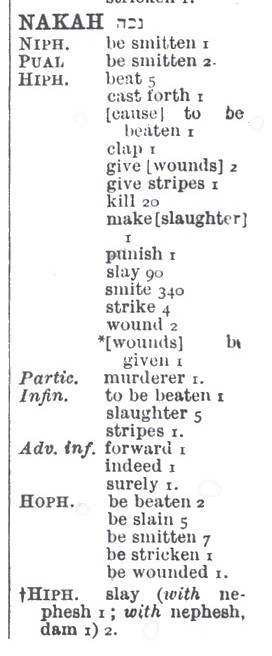 |
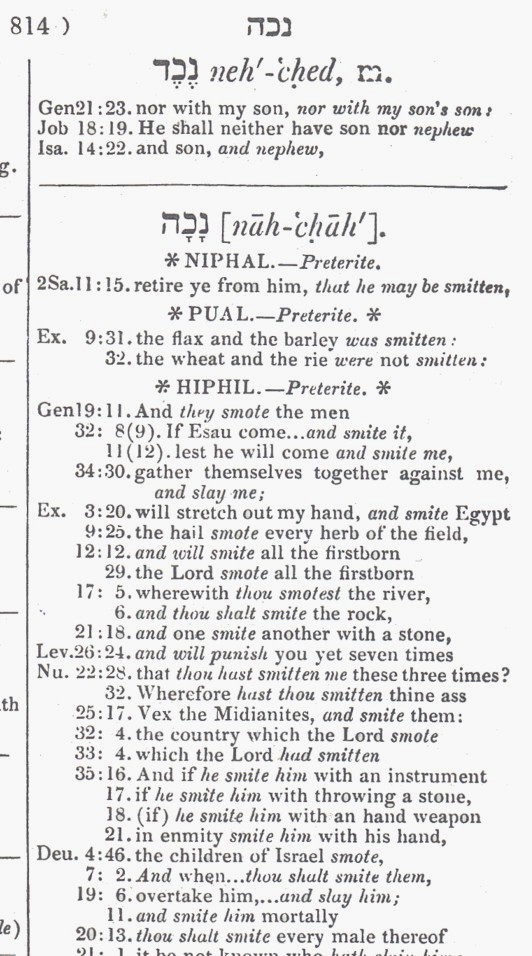 |
3
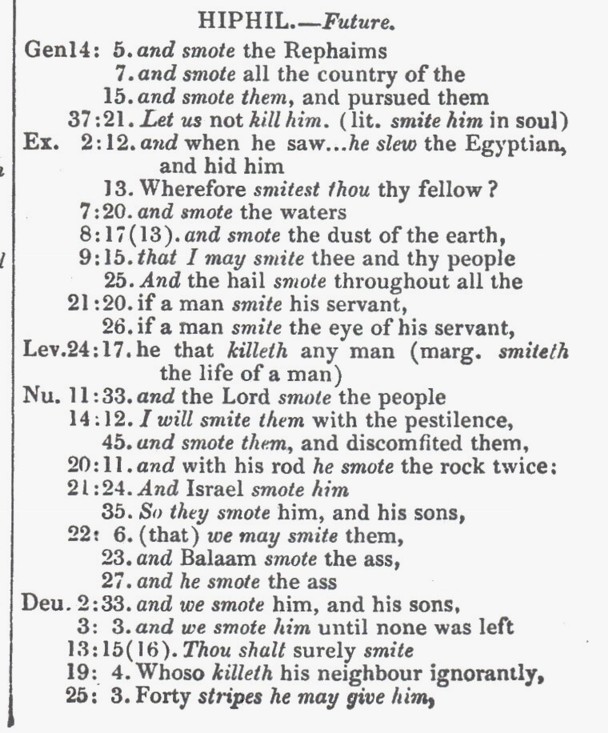 |
REGULATION WITH LAW DOES NOT IMPLY CONDONING
When first mentioned in the Old Testament slavery is just there. It's not instituted by God but part of global culture along with polygamy, war, murder, idolatry, human sacrifice, class divisions, subjugation of women, rule by kings, and the human inclination to do evil. (Genesis 8:21)
Genesis 14 records a slave raid; and round 1500 BC Israel was an enslaved nation. (Exodus 1:11-16)
Slavery — i.e. savage slavery without human rights, where slaves could be sacrificed to idols, raped, worked to death, castrated, etc — was a fundamental part of the global economy like money, agriculture, land and trade. A nation without slavery would have invited economic self-destruction, as would any nation now that disregarded whatever is essential for economic survival.
God's love and concern is seen in Israel's laws that made slavery temporary for Israelites, and benign for all slaves.
The Bible also teaches that God created humans. That would make God their owner, and to enslave a free person would amount to stealing from God. The New Testament teaches that Christ died for the sins of all humankind and thereby ransomed or purchased the human race. (Revelation 5:9) That makes Christ the owner. Therefore, expressed simply, the Old Testament allowed benign, safe slavery, but both Testaments taught principles that undermined slavery. Paul the Apostle wrote, "Become free if possible" and Christians in the Roman Empire were noted for buying the freedom of Christian slaves.
God's intervention in world history with laws to make slavery humane does not as Straughen claims, sanction slavery.
Most 20th century governments support laws that during war protect non-combatants from reprisals, stipulate care for wounded and sick prisoners, and oppose torture. Straughen's terrible logic would condemn protective clauses in the Geneva Conventions as endorsements of war. Such clauses however, don't endorse war but, given that wars occur, endorse protection.
The overall biblical position on slavery is similar. The Old Testament, given that slavery was a worldwide institution, had laws to make it tolerable, but also taught principles that undermined it. (See above) All nations disagreed with making slavery humane, but all nations were wrong!
Roman slaves, 15 centuries after Moses, were property without rights, often used as sex slaves.
Muslims kidnapped 17 million Africans for lifelong slavery in the Middle East, and initiated 7 million of them by castrating them. Islamic cruelty sparked history's greatest slave rebellion in 862 CE which took 14 bloody years to suppress.
Caribbean areas similarly lacked laws and enforcement to protect slaves, resulting in slaves tortured and mutilated, and slave-owner families suffering vengeance during slave rebellions. (Johnson 2013)
The Soviet slave-labor camps, the Gulag, operated 1920s to 1950s. Of 18 million prisoners, 2 million died from starvation, overwork, disease, and executions. The brains and executives behind the Gulag were Communists and atheists.
Payne (1975) gives a brief description:
The camps were designed to punish prisoners by a long process of
degradation. Sentences were usually ten or twenty years, and all those
days and nights were spent in total misery. Each food bowl was shared
by four or five half-starved prisoners; latrines were inadequate; and
bunks too few and too crowded to permit restful sleep. As in the German
prison camps, common criminals, thieves and murderers were given
positions of authority…
While millions of people were being degraded and massacred, the Soviet Union continued to advertise itself as a workers' paradise.
While millions of people were being degraded and massacred, the Soviet Union continued to advertise itself as a workers' paradise.
Starvation, degradation, massacre, no six-year limit, no escape if mistreated, and no impartial justice! Atheistic Gulag slavery was "wanton cruelty and ignorance of the basest kind", not humane like the Law of Moses. (Proverbs 28:5)
ABOLITION — HOW?
The literacy rate in England around 1800 CE, according to Copilot, was 60% of men, 40% of women. Most had only basic reading skill "focused on religion or practical tasks rather than long hours in solitary reading."
Therefore the claim that "inherent equality arguments" by John Locke and Jean-Jacques Rousseau shifted public opinion regarding slavery is nonsense. The public didn't have time or skill to study philosophy, in fact very few do even now. The idea of inherent equality is actually from the Bible — the book the British public heard about and was read in churches. Equality is an obvious inference from the Bible's teaching that God created all nations from one man. Philosophers got their best ethical ideas from the Bible!
Quakers stand out in the 18th and 19th century fight to end the slave trade and slavery. Granville Sharp (1735-1813) authored A Representation of the Injustice and Dangerous Tendency of Tolerating Slavery in England (1769) wherein he provided many legal arguments against slavery. He was also co-founder in 1787 of the Society for Effecting the Abolition of the Slave Trade.
Another book which "attracted great public interest", and launched Britain's abolitionist campaign, was An Essay on the Treatment and Conversion of African Slaves in British Sugar Colonies (1784) by Reverend James Ramsay (1733-1789).
Then followed An Essay on the Slavery and Commerce of the Human Species, Particularly the African (1786) by Thomas Clarkson (1760-1846), another Quaker and cofounder.
Reverend Ramsay pointed out what I've also noted:
"while he [Moses] allowed them [Israelites] to make slaves of the
conquered
Canaanites and their posterity, he endeavoured to render their lot easy, and
the behaviour of masters humane…" (p. 19)
Canaanites and their posterity, he endeavoured to render their lot easy, and
the behaviour of masters humane…" (p. 19)
Ramsay says that only the Athenians came close to Old Testament humanity in the treatment of slaves. (pp 20-23) And: "The English have not paid the least attention to enforce by a law, either humanity or justice, as these may respect their slaves." (p. 62)
People who follow Moses' Ten Commandments are today among the world's most crime-free citizens, and their religions often outstanding builders of schools and hospitals. Ramsay similarly wrote: "For his laws continue, at this day, to be obeyed, in the most inconvenient circumstances, while all other laws of former ages are lost in the gulph of time…" (p. 24)
Ramsay also argued that the intellectual inferiority of Negroes is due to lack of opportunity, denial of education, and suppression of their skills. When I studied Social Biology at university, 200 years after Ramsay's book, the same points were made!
Evidence of Negro ability existed already in the 1770s. John and Susannah Wheatley, practicing Christians of Boston, purchased a slave-girl who had been kidnapped from West Africa at age 8, and encouraged her education. Phillis Wheatley (1753-1784) "mastered classical literature, theology, and poetry", and achieved international recognition for her book Poems on Various Subjects, Religious and Moral (1773). Her poetry topics included slavery and the line: " 'Twas mercy brought me from my Pagan land, Taught my benighted soul to understand…" The future first president, George Washington, corresponded with Phyllis and praised her writing skills.
Returning to Locke and Rousseau: For Britain's abolition campaign to succeed required Parliament to change the law. Readers of John Locke (1632-1704) and Jean Jacques Rousseau (1712-1778) on equality and freedom, presumably included parliamentarians as these, unlike the public, were able readers. The philosophers/humanists read the Bible and got their best ideas from it, and abolitionists cited them in anti-slavery debates. Locke believed the Bible and authored The Reasonableness of Christianity (1695). Nevertheless most parliamentarians voted repeatedly against emancipation, and at least one owned a slave plantation. Wilberforce and fellow abolitionists were also accused of being traitors when the French Revolution, based on slogans of equality, beheaded French nobility and went to war with England to take the revolution there.
England was supposedly "Christian". Yet 25% of unmarried women in London were prostitutes; some brothels exclusively offered girls aged under 14. Cruel sports like bull-baiting in which dogs fought bulls, tearing their tender snout and themselves trampled with backs broken, were popular. Public executions provided entertainment and drunkenness afflicted most people from infants to the aged, and parliamentarians sometimes attended parliament when drunk. Gambling was rife nationwide, the Prince of Wales set the example. Besides bedding 7000 women he accumulated gambling debts roughly equivalent now to $1000m, but was repeatedly bailed out by the Royal Treasury.
As mentioned, not many people could read well or had the time. The mistreatment of slaves in British colonies was unknown until abolitionists exposed it, but with the public's own lives and ethics so squalid few cared.
The anti-slavery campaign necessitated a simultaneous "Reformation of Manners" campaign to lift public awareness and reintroduce Christian ethics. Wilberforce's book A Practical View of the Prevailing Religious System of Professed Christians (1797) emphasized spiritual regeneration and pursuing "the real nature and principles of the religion which they claim to profess." It became a "best seller".
Abolition of slavery was a decades-long, exhausting, dangerous struggle by Christian abolitionists — some died prematurely from the stress — against the opposition of slave owners, slave-ship captains, other vested interests, and even parliamentarians. Did Locke's and Rousseau's philosophy end slavery? It helped, but to claim more steals the credit from those who did the hard work. The error is similar as attributing discoveries of modern science to the pathetic knowledge of a thousand years earlier!
The Old Testament's laws to protect slaves and treat them humanely were 3500 years ahead of the times (Deuteronomy 4:8) and inspired the Abolitionist Movement in Britain. Slavery wasn't ended as Straughen claims by a few philosophers, but by decades of Christian lobbying in Parliament and by promoting the cause across England.
Straughen says a "creator of heaven" would demand and himself show:
- Inherent Dignity and Equality
- Love and Compassion
- Moral Leadership
- Hellish elements of slavery
- Dehumanization
- Long term trauma
- Social inequality
CONCLUSION
Most of the points made above, were made 25 years ago in #76 with the conclusion, "The demise of slavery is among the numerous benefits of the 'Word of God' to the modern world." (p.44)
Straughen pretends he wants answers, but after he gets them he ignores them. His methods and thinking resemble his description of religion — "largely dogmatism based on faith rather than sound evidence..." He leaped to "unjustified conclusions"; "gave up rationality from the start"; changed the meaning of words; misrepresented the Bible; and employed the furphy of crediting modern scientific achievements to forbears too remote to have direct effect. He has swallowed the "New Atheism" described by Hart (2009) as: "vacuous arguments afloat on oceans of historical ignorance, made turbulent by strident self righteousness." (Hart 2009)
REFERENCES:
[ * Books available on the Worldwide Web ]
Adelard of Bath https://en.widipedia.org/wiki/Adelard_of_Bath
Augarten, S. 1984 BIT BY BIT An Illustrated History of Computers, Unwin, pp 15-18
Babbage, C. https://en.wikipedia.org/wiki/Charles_Babbage
Bonnell, K.L. 2008 Doctoral Study, Walden University
http://books_google.com/books?isbm=0549461418
Clarkson, T. 1786 An Essay On The Slavery And Commerce Of The Human Species, London*
Four Humors https://en.wikipedia.org/wiki/_Humorism
Geneva Conventions https://en.wikipedia.org/wiki/Geneva_Conventions
Hart, D. B. 2009 Atheist Delusions: The Christian Revolution and its Fashionable Enemies, Yale University*
Holy Bible, New Revised Standard Version, Zondervan, p. 218
Investigator Magazine
#76 The Bible on Slavery
#169 Science and Christianity
#170 Origin of Modern Science
#171 Origin of Modern Science—[Straughen's] Final Reply
#172 Modern Science and Christianity
#212 Origins of Modern Medical Treatment
#221 Reason and Religion
#222 Reason and Religion in #221 Needs More Reason
#223 Reply to Anonymous' Comments on Reason and Religion
# 224 "Reason & Religion" Again Needs More Reason
#225 Reason & Religion — A Final Reply
#169 Science and Christianity
#170 Origin of Modern Science
#171 Origin of Modern Science—[Straughen's] Final Reply
#172 Modern Science and Christianity
#212 Origins of Modern Medical Treatment
#221 Reason and Religion
#222 Reason and Religion in #221 Needs More Reason
#223 Reply to Anonymous' Comments on Reason and Religion
# 224 "Reason & Religion" Again Needs More Reason
#225 Reason & Religion — A Final Reply
John of Seville
https://en.wikipedia.org.wiki/John_of_Seville
https://en.wikipedia.org/wiki/Toledo_School_of_Translators
Johnson, S.M. 2013 Unknown Wars of Asia, Africa and the America's That Changed History, Atlas World Publishing
Lovelace, A. https://en.wikipedia.org/wiki/Ada_Lovelace
Metaxas, E. 1988 Amazing Grace, Authentic
Payne, R. 1975 The Corrupt Society From Ancient Greece to Present-Day America, Praeger Publications
Poytnz, A. 1845 A World of Wonders, Chapter 39, Richard Bentley publisher*
Ramsay, Reverend James 1784 An Essay on the Treatment and Conversion of African Slaves in British Sugar Colonies*
Sharpe, G. 1769 A Representation of the Injustice and Dangerous Tendency of Tolerating Slavery in England, London *
Sharpe, G. https://en.wikipedia.org/wiki/Granville_Sharp
Wigram, G.V. Englishman's Hebrew and Chaldee Concordance of the Old Testament, Samuel Bagster & Sons
Wilberforce, W. 1797 A Practical View of the Prevailing Religious System of Professed Christians, in the Middle and Higher Classes in this Country, Contrasted with Real Christianity, Robert Dapper*
Young, R. Analytical Concordance to the Holy Bible, Eighth Edition 1939, Reprint 1967, Lutterworth Press
DIFFERENCE BETWEEN BEATING and BEING STRUCK
IN THE CONTEXT OF VIOLENCE
IN THE CONTEXT OF VIOLENCE
Copilot
CONTEXTUAL NUANCES
Beating: Repeated physical blows, often sustained over time. Suggests prolonged violence or abuse
Struck: A single hit or blow, possibly isolated. Implies a discrete act of violence
The distinction can be subtle but meaningful, especially in legal, journalistic, or humanitarian contexts.
Beating:
• Often implies intentional, prolonged harm.
• Can be associated with punishment, torture, or assault.
• Carries emotional weight—evokes images of someone being overpowered or brutalized.
• Used in phrases like “suffered a brutal beating” or “subjected to a beating.”
Struck:
• More neutral or clinical—describes the act of impact.
• Can be accidental or deliberate, but doesn’t imply repetition.
• Common in legal or medical reports: “The victim was struck on the head.”
WHY IT MATTERS
In humanitarian reporting or legal testimony, saying someone was “struck” might understate the severity if the violence was sustained. Conversely, “beating” conveys a pattern of abuse, which could be crucial for understanding trauma, intent, or legal culpability.
"BEATING" and "BEING STRUCK"
IN CONTEXTS OF VIOLENCE, ABUSE, OR CONFLICT
IN CONTEXTS OF VIOLENCE, ABUSE, OR CONFLICT
In legal frameworks—especially under international humanitarian law (IHL) and human rights law—the distinction between "beating" and "being struck" can influence the severity of charges:
• Beating may be classified as torture, inhuman treatment, or cruel punishment, especially if it’s systematic or prolonged.
• Being struck might be categorized as assault or excessive use of force, depending on context.
Legal bodies like the International Criminal Court (ICC) or UN Human Rights Council often rely on precise language to assess patterns of abuse. “Beating” suggests repetition and intent, which can support claims of war crimes or crimes against humanity.
Survivors may describe a “beating” to convey ongoing trauma, while “struck” might refer to a single incident. This affects how cases are built and interpreted.
"BEATING" AND "BEING STRUCK"
IN MEDIA COVERAGE
IN MEDIA COVERAGE
"Beating" is more likely to appear in investigative journalism or human rights reporting, where the goal is to expose patterns of abuse.
"Struck" is often used in breaking news or official statements, especially when legal liability is uncertain.
The Oxford Public International Law entry notes how mass media shapes international relations by selectively amplifying certain narratives. The choice between “beating” and “struck” can subtly influence public perception and diplomatic response.
This Matters in Humanitarian Contexts. In conflict zones or refugee testimonies, distinguishing between "beating" and "strike" terms helps to:
• Establish patterns of abuse (e.g., repeated beatings in detention centers)
• Support asylum claims (e.g., proving persecution)
• Guide policy responses (e.g., sanctions, peacekeeping mandates).
| Typical Contents |
Implications in Reporting |
|
| Beat |
Brutality, Domestic abuse, War Crimes |
Evokes brutality, Systematic violence |
| Struck |
Protest clashes, Accidental harm, Isolated acts |
More neutral, Less emotionally charged |
(Reformatted and rewritten from Copilot
https://copilot.microsoft.com/ 2025)
https://copilot.microsoft.com/ 2025)
Skeptics and atheists versus religion and the paranormal, on this website: